A five-digit integer is made using each of the digits 1,3,5,7,9. The integer is greater than 80 000 and less than 92 000. The units (ones) digit is 3. The hundreds and tens digits, in that order, form a two-digit integer that is divisible by 5. What is the five-digit integer?
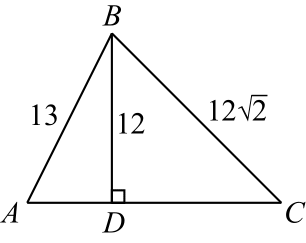
Consider triangle ABC. Point D is on AC so that BD is perpendicular to AC. Also, AB=13, BC=122 and BD=12. What is the length of AC?
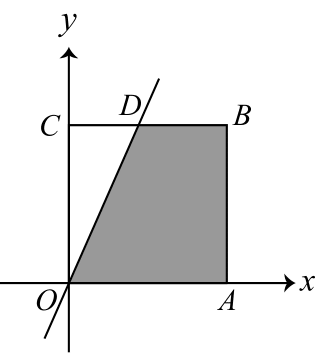
In the diagram, square OABC has side length 6. The line with equation y=2x intersects CB at D. Determine the area of the shaded region ODBA.
Solution
Suppose that the five-digit integer has digits abcde.
The digits a,b,c,d,e are 1,3,5,7,9 in some order.
Since abcde is greater than 80 000, then a≥8, which means that a=9.
Since 9bcde is less than 92000, then b lt;2, which means that b=1.
Since 91cde has units (ones) digit 3, then e=3.
So far, the integer is 91cd3, which means that c and d are 5 and 7 in some order.
Since the two-digit integer cd is divisible by 5, then it must be 75.
This means that the the five-digit integer is 91753. By the Pythagorean Theorem in △ADB, AD2=AB2−BD2=132−122=169−144=25 Since AD gt;0, then AD=25=5.
By the Pythagorean Theorem in △CDB, CD2=BC2−BD2=(122)2−122=122(2)−122=122 Since CD gt; 0, then CD=12.
Therefore, AC=AD+DC=5+12=17. Solution 1
The area of the shaded region equals the area of square OABC minus the area of △OCD.
Since square OABC has side length 6, then its area is 62 or 36.
Also, OC=6.
Since the equation of the line is y=2x, then its slope is 2.
Since the slope of the line is 2, then CDOC=2.
Since OC=6, then CD=3.
Thus, the area of △OCD is 21(OC)(CD)=21(6)(3)=9.
Finally, the area of shaded region must be 36−9=27.
Solution 2
Since square OABC has side length 6, then OA=AB=CB=OC=6.
Since the slope of the line is 2, then CDOC=2.
Since OC=6, then CD=3.
Since CB=6 and CD=3, then DB=CB−CD=3.
The shaded region is a trapezoid with parallel sides DB=3 and OA=6 and height AB=6.
Therefore, the area of the shaded region is 21(DB+OA)(AB)=21(3+6)(6)=27.
Want a route through all this instead of an archive? The track
puts 2,604 problems in a working order, from Junior Challenge level to the IMO shortlist.