Maths Olympiad Prep

Library / /89 of 187

, 2013

Algebra Difficulty 2.1 Junior Prove it Canada

If 21x=7y\dfrac{21}{x}=\dfrac{7}{y} with x0x \neq 0 and y0y\neq 0, what is the value of xy\dfrac{x}{y}?

For which positive integer nn are both 1 n+1 lt;0.2013\text{1 n+1 lt;0.2013} and 0.2013 lt; 1 n\text{0.2013 lt; 1 n} true?
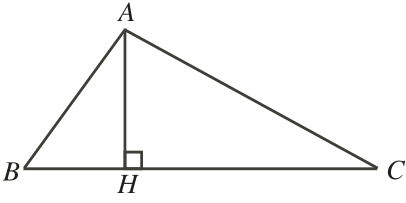
In the diagram, HH is on side BCBC of ABC\triangle ABC so that AHAH is perpendicular to BCBC. Also, AB=10AB=10, AH=8AH=8, and the area of ABC\triangle ABC is 84. Determine the perimeter of ABC\triangle ABC.

Figure 0

Solution

Since 21x=7y\dfrac{21}{x}=\dfrac{7}{y}, then 21=7xy21 = \dfrac{7x}{y} or xy=217=3\dfrac{x}{y}=\dfrac{21}{7}=3.
Solution 1

Since 130.333314=0.2515=0.2160.1667\dfrac{1}{3} \approx 0.3333 \qquad \dfrac{1}{4} = 0.25 \qquad \dfrac{1}{5} = 0.2 \qquad \dfrac{1}{6} \approx 0.1667 then 1 5 lt; 0.2013\text{1 5 lt; 0.2013} and 0.2013 lt; 1 4\text{0.2013 lt; 1 4}, so nn must equal 4.

(We should note as well that 1n\dfrac{1}{n} decreases as nn increases, so this is the only integer value of nn that works.)

Solution 2

Since 1 n+1 lt;0.2013\text{1 n+1 lt;0.2013}, then n+1 gt; 1 0.2013\text{n+1 gt; 1 0.2013} or n gt; 1 0.2013 -1 3.9677\text{n gt; 1 0.2013 -1 3.9677}.

Since 1 n gt; 0.2013\text{1 n gt; 0.2013}, then n lt; 1 0.2013 4.9677\text{n lt; 1 0.2013 4.9677}.

Since nn is a positive integer

that is smaller than a number that is approximately 4.9677, and
that is larger than a number that is approximately 3.9677,

then n=4n=4.
Since AHAH is perpendicular to BCBC, then the area of ABC\triangle ABC equals 12(BC)(AH)\frac{1}{2}(BC)(AH).

Since we are told that this area equals 84 and AH=8AH=8, then 84=12(BC)(8)84 = \frac{1}{2}(BC)(8) or 4BC=844\cdot BC = 84 or BC=21BC=21.

Also, since AHB\triangle AHB is right-angled at HH, then by the Pythagorean Theorem, BH=AB2AH2=10282=36=6BH = \sqrt{AB^2-AH^2}=\sqrt{10^2-8^2}=\sqrt{36}=6 since BH gt;0\text{BH gt;0}. (We could also have recognized two sides of a 6-8-10 right-angled triangle.)

Since BC=21BC=21 and BH=6BH=6, then HC=BCBH=216=15HC = BC-BH=21-6=15.

Since AHC\triangle AHC is right-angled at HH, then by the Pythagorean Theorem, AC=AH2+HC2=82+152=289=17AC = \sqrt{AH^2 + HC^2} = \sqrt{8^2+15^2}=\sqrt{289} = 17 since AC gt;0\text{AC gt;0}.

Finally, the perimeter of ABC\triangle ABC equals AB+BC+ACAB+BC+AC or 10+21+1710+21+17, which equals 48.

Figure for this problem

Want a route through all this instead of an archive? The track puts 2,604 problems in a working order, from Junior Challenge level to the IMO shortlist.

Source: CEMC, University of Waterloo, licensed CC-BY-NC-4.0. Statement reproduced verbatim; metadata (topic, difficulty) added by this project.