In the square shown, is equal to
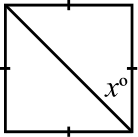
CEMC Gauss (Grade 7), 2017
Pick one
Solution
Solution 1
Three vertices of the square are labelled , , and such that is the diagonal and measures .
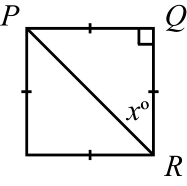
Since the given figure is a square, then and .
Since , is isosceles and so .
The three angles in any triangle add to and since , then .
Since , then , and so .
Solution 2
The vertices of the square are labelled , , , and such that is the diagonal and measures .
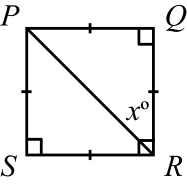
Diagonal divides square into two identical triangles: and .
Since these triangles are identical, .
Since is a square, then .
That is, or or and so .
Want a route through all this instead of an archive? The track
puts 2,604 problems in a working order, from Junior Challenge level to the IMO shortlist.