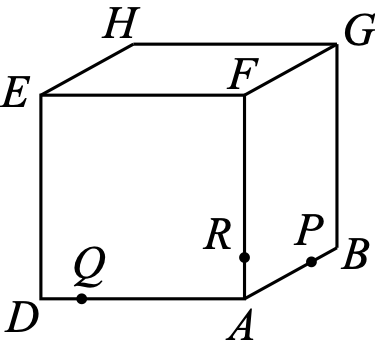
Cube ABCDEFGH has edge length 100. Point P is on AB, point Q is on AD, and point R is on AF, as shown, so that AP=x, AQ=x+1 and AR=2xx+1 for some integer x.
For how many integers x is the volume of triangular-based pyramid APQR between 0.04% and 0.08% of the volume of cube ABCDEFGH? (The volume of a pyramid is equal to one-third of the area of its base times its height.)
A number or a short expression. Fractions can be typed as 3/2, and spacing doesn't matter.
Solution
Triangular-based pyramid APQR can be thought of as having triangular base △APQ and height AR.
Since this pyramid is built at a vertex of the cube, then △APQ is right-angled at A and AR is perpendicular to the base.
The area of △APQ is 21×AP×AQ=21x(x+1). The height of the pyramid is 2xx+1.
Thus, the volume of the pyramid is 31×21x(x+1)×2xx+1 which equals 12(x+1)2.
Since the cube has edge length 100, its volume is 1003 or 1000000.
Now, 1% of 1 000 000 is 1001 of 1 000 000 or 10 000.
Thus, 0.01% of 1 000 000 is 1001 of 10 000 or 100.
This tells us that 0.04% of 1 000 000 is 400, and 0.08% of 1 000 000 is 800.
We want to determine the number of integers x for which 12(x+1)2 is between 400 and 800.
This is equivalent to determining the number of integers x for which (x+1)2 is between 12×400=4800 and 12×800=9600.
Since 4800≈69.28 and 9600≈97.98, then the perfect squares between 4800 and 9600 are 702,712,722,…,962,972.
These are the possible values for (x+1)2 and so the possible values for x are 69,70,71,…,95,96.
There are 96−69+1=28 values for x.
Want a route through all this instead of an archive? The track
puts 2,604 problems in a working order, from Junior Challenge level to the IMO shortlist.