In the diagram, a figure is drawn on a grid using eight semi-circles
whose diameters are , , , , , , , and .
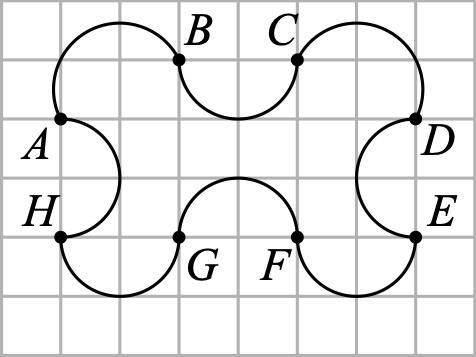
Suppose that the area of the figure is and that is the closest integer to . What is the sum of the digits of
?
In the diagram, a figure is drawn on a grid using eight semi-circles
whose diameters are , , , , , , , and .
Suppose that the area of the figure is and that is the closest integer to . What is the sum of the digits of
?
Draw line segments from to
, to ,
to , to ,
to , to ,
to , and to , as shown.
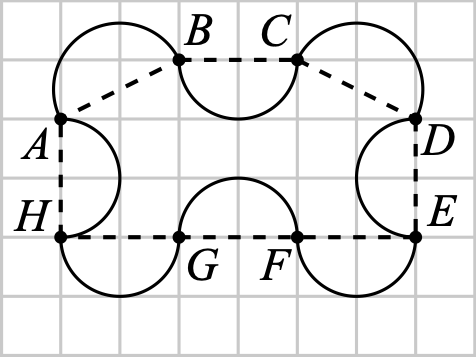
The line segments , , , , , and each have a length of units.
Hence, the radii of the semicircles with these diameters are all , and the areas of the circles with
these diameters are all .
The line segment is the
hypotenuse of a triangle with legs of length and .
By the Pythagorean Theorem, the length of is .
The radius of the semicircle with diameter is , so its area is .
By similar reasoning, the area of the semicircle with diameter is also .
The area of the figure can be computed as the area of hexagon plus the areas of the semicircles
with diameters , , , and , minus the areas of the semicircles
with diameters , , , and .
We have already computed the areas of the semicircles, so we now need to
compute the area of hexagon .
This hexagon can be viewed as a rectangle with two “corners” removed. These “corners” are
right-angled triangles with hypotenuses and .
The legs of these two triangles have length and , so their areas are each .
Thus, the area of hexagon is
.
Using the areas of the semicircles computed earlier, we can now compute
the area of the figure as Thus, , so . Rounding to the
nearest integer, we get , so
the answer is .