Consider the diagram of square .
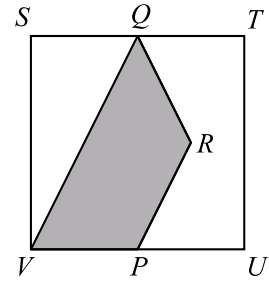
In the diagram,
and are the midpoints of and ,
, and
is parallel to .
What is the ratio of the shaded area to the unshaded area?
Consider the diagram of square .
In the diagram,
and are the midpoints of and ,
, and
is parallel to .
What is the ratio of the shaded area to the unshaded area?
Pick one
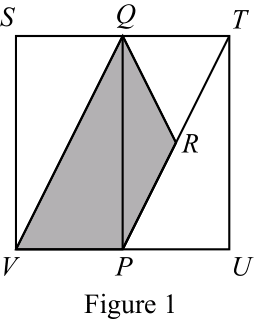
We begin by joining to .
Since and are the midpoints of and , then is parallel to both and and rectangles and are identical.
In rectangle , is a diagonal.
Similarly, since is parallel to then extended to is a diagonal of rectangle , as shown in Figure 1.
In Figure 2, we label points , and , the midpoints of and , respectively.
We join to , to and to , with intersecting at the centre of the square , as shown.
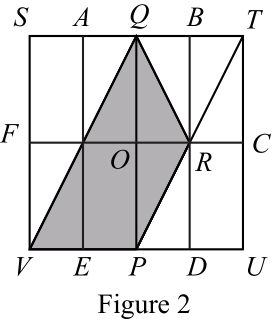
Since and lies on diagonal , then both and pass through . (That is, is the centre of .)
The line segments and divide square into 8 identical rectangles.
In one of these rectangles, , diagonal divides the rectangle into 2 equal areas.
That is, the area of is half of the area of rectangle .
Similarly, the area of is half of the area of rectangle .
Rectangle has area equal to 4 of the 8 identical rectangles.
Therefore, has area equal to 2 of the 8 identical rectangles (since diagonal divides the area of in half).
Thus the total shaded area, which is , is equivalent to the area of or 3 of the identical rectangles.
Since square is divided into 8 of these identical rectangles, and the shaded area is equivalent to the area of 3 of these 8 rectangles, then the unshaded area occupies an area equal to that of the remaining or 5 rectangles.
Therefore, the ratio of the shaded area to the unshaded area is .