The coordinates of three of the vertices of a parallelogram are , and . What is the area of this parallelogram?
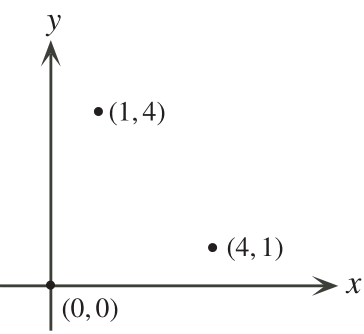
The coordinates of three of the vertices of a parallelogram are , and . What is the area of this parallelogram?
We label the three points as , and .
There are three possible locations for the fourth vertex of the parallelogram – between and (in the second quadrant), between and (in the first quadrant), and between and (in the fourth quadrant).
In each of these cases, will make up half of the parallelogram, and so the area of the parallelogram is twice the area of .
There are many ways to calculate the area of .
We proceed by “completing the rectangle" which includes the-axis, the -axis, the line , and the line .
We label the point as , the point as , and the point as .
(Note that rectangle is in fact a square, so we have “completed the square"!)
The area of equals the area of rectangle minus the combined areas of , , and .
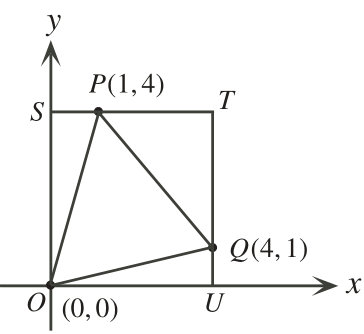
The area of rectangle is , since it is a square with side length .
Consider . It is right-angled at , with and .
Thus, its area is .
Consider . It is right-angled at , with .
Thus, its area is .
Consider . It is right-angled at , with and .
Thus, its area is .
Therefore, the area of is .
Thus, the area of the parallelogram is .