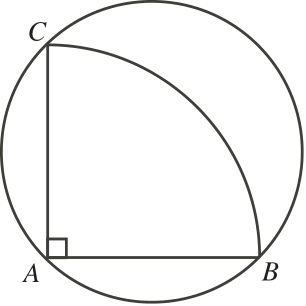
In the diagram, ABC is a quarter of a circular pizza with centre A and radius 20 cm. The piece of pizza is placed on a circular pan with A, B and C touching the circumference of the pan, as shown. What fraction of the pan is covered by the piece of pizza?
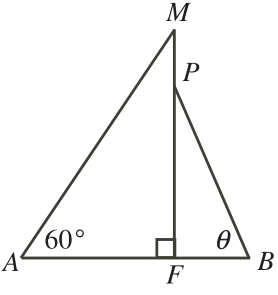
The deck AB of a sailboat is 8 m long. Rope extends at an angle of 60∘ from A to the top (M) of the mast of the boat. More rope extends at an angle of θ from B to a point P that is 2 m below M, as shown. Determine the height MF of the mast, in terms of θ.
Solution
Since ABC is a quarter of a circular pizza with centre A and radius 20 cm, thenAC=AB=20 cm.
We are also told that ∠CAB=90∘ (one-quarter of 360∘).
Since ∠CAB=90∘ and A, B and C are all on the circumference of the circle, then CB is a diameter of the pan. (This is a property of circles: if X, Y and Z are three points on a circle with ∠ZXY=90∘, then YZ must be a diameter of the circle.)
Since △CAB is right-angled and isosceles, then CB=2AC=202 cm.
Therefore, the radius of the circular plate is 21CB or 102 cm.
Thus, the area of the circular pan is (10 2 cm ) 2 = 200 cm 2.
The area of the slice of pizza is one-quarter of the area of a circle with radius 20 cm, or 1 4 (20 cm ) 2 = 100 cm 2.
Finally, the fraction of the pan that is covered is the area of the slice of pizza divided by the area of the pan, or 100 cm 2 200 cm 2 = 1 2. Suppose that the length of AF is x m.
Since the length of AB is 8 m, then the length of FB is (8−x) m.
Since △MAF is right-angled and has an angle of 60∘, then it is 30∘-60∘-90∘ triangle.
Therefore, MF=3AF, since MF is opposite the 60∘ angle and AF is opposite the 30∘ angle.
Thus, MF=3x m.
Since MP=2 m, then PF=MF−MP=(3x−2) m.
We can now look at △BFP which is right-angled at F.
We have = PF FB = ( 3 x-2) m (8-x) m = 3 x-2 8-x Therefore, (8−x)tanθ=3x−2 or 8tanθ+2=3x+(tanθ)x.
This gives 8tanθ+2=x(3+tanθ) or x=tanθ+38tanθ+2.
Finally, MF=3x=tanθ+383tanθ+23 m.
Want a route through all this instead of an archive? The track
puts 2,604 problems in a working order, from Junior Challenge level to the IMO shortlist.