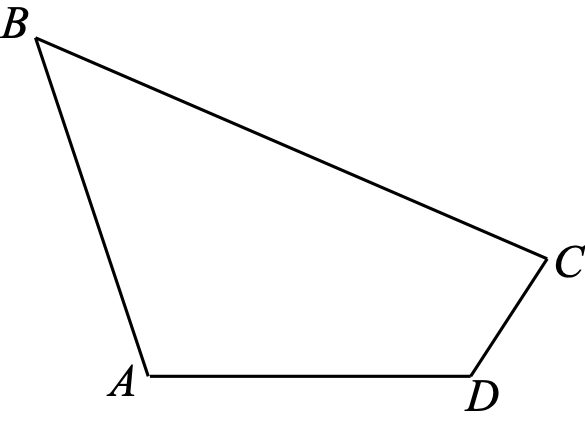
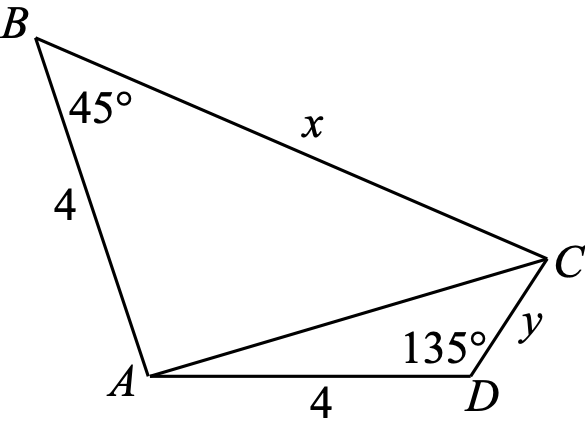
Xander, Yasmin and Zhe each have a rope. Xander's rope is 10 m long. Yasmin's rope is n% longer than Xander's rope. Zhe's rope is (2n)% longer than Yasmin's rope. Zhe's rope is (3.14n)% longer than Xander's rope. If n gt; 0, what is the value of n? In the diagram, quadrilateral ABCD has AB=AD=4. Also, ∠ABC=45° and ∠CDA=135°.
Determine the exact value of BC−CD.
Solution
Xander's rope is 10 m long.
Since Yasmin's rope is n% longer than Xander's rope, then the length of Yasmin's rope is 10(1+100n) m.
Since Zhe's rope is (2n)% longer than Yasmin's rope, then the length of Zhe's rope is 10(1+100n)(1+1002n) m.
Since Zhe's rope is (3.14n)% longer than Xander's rope, then the length of Zhe's rope can also be written as 10(1+1003.14n) m.
Therefore, 10(1+100n)(1+1002n)(1+100n)(1+1002n)(100+n)(100+2n)10000+300n+2n22n2−14n2n(n−7)amp;=10(1+1003.14n)amp;=(1+1003.14n)amp;=100(100+3.14n)amp;=10000+314namp;=0amp;=0amp;(multiplying by 100⋅100) Since n gt; 0, then it must be the case that n=7. Solution 1:
Let BC=x and CD=y. Join A to C.
Using the cosine law in △ABC, we obtain AC2amp;=AB2+BC2−2(AB)(BC)cos(∠ABC)amp;=16+x2−8xcos(45°)amp;=16+x2−8x(21)amp;=16+x2−42x Using the cosine law in △ADC, we obtain AC2amp;=AD2+DC2−2(AD)(DC)cos(∠ADC)amp;=16+y2−8ycos(135°)amp;=16+y2−8y(−21)amp;=16+y2+42y Equating expressions for AC2, we obtain 16+x2−42xx2−y2−42x−42y(x+y)(x−y)−42(x+y)(x+y)(x−y−42)amp;=16+y2+42yamp;=0amp;=0amp;=0 Since x gt; 0 and y gt; 0, then x + y gt; 0. Thus, x−y−42=0 and so BC−CD=x−y=42.
Solution 2:
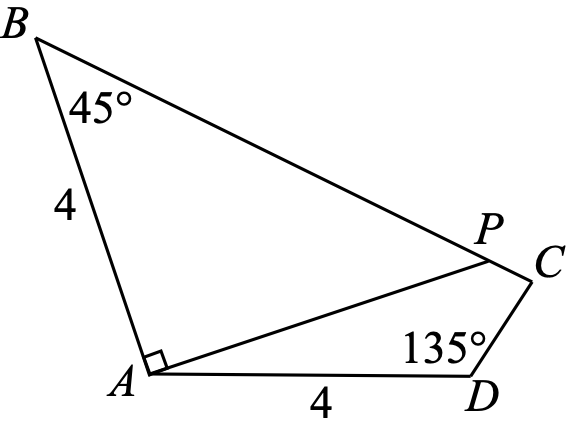
Let point P be on BC so that AP is perpendicular to AB.
To see why P is on BC (and not some extension of BC) first observe that isosceles △BAD has ADB = ABD lt; ABC = 45, so BAD = 180 - ADB - ABD gt; 180 - 45 - 45 = 90 Therefore, ∠BAD is obtuse.
Now suppose P were on some extension of BC. Since ∠BAD is obtuse and ∠BAP=90°, AP must intersect CD at some point M, and so AM lt;AP. However, AP=AB=4 since △BAP is is a right-isosceles triangle, which means in △AMD, we have that AM is not the longest side while it is opposite obtuse ∠ADM. This is impossible, so we conclude that P must be on BC.
It was mentioned above that △BAP is right-angled and isosceles, with AP=AB=4 which means that BP=2AB=42.
Since ∠BPA=45° and BPC is a straight angle, then ∠CPA=180°−∠BPA=135°. Therefore, ∠APC=∠ADC.
Since AP=AD=4, then △APD is isosceles, and so ∠APD=∠ADP. Then ∠CPD=∠APC−∠APD=∠ADC−∠ADP=∠CDP Since ∠CPD=∠CDP, then △CPD is isosceles, and so CD=CP. Thus, BC−CD=BC−CP=BP=42.
Want a route through all this instead of an archive? The track
puts 2,604 problems in a working order, from Junior Challenge level to the IMO shortlist.