Two joggers each run at their own constant speed and in opposite directions from one another around an oval track. They meet every 36 seconds. The first jogger completes one lap of the track in a time that, when measured in seconds, is a number (not necessarily an integer) between 80 and 100. The second jogger completes one lap of the track in a time, seconds, where is a positive integer. The product of the smallest and largest possible integer values of is
CEMC Gauss (Grade 8), 2015
Pick one
Solution
We can determine which triangle has the greatest area by using a fixed side length of 4 for each of the identical squares and using this to calculate the unknown areas.
We begin by constructing and noticing that it is contained within square , as shown.
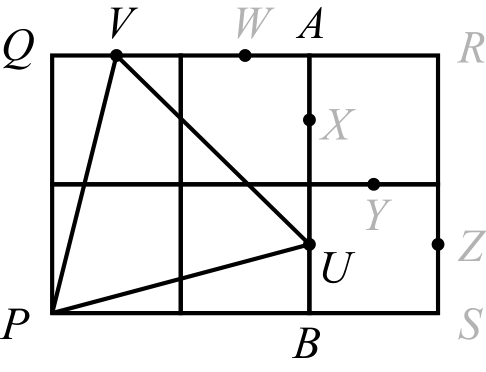
The area of is determined by subtracting the areas of triangles , and from the area of square .
Since and , then the area of square is .
Since and , then the area of is .
Since and , then the area of is .
Since and , then the area of is .
Therefore, the area of is .
Next, we construct and then construct rectangle by drawing parallel to through . Further, is the midpoint of the side of a square and so and are also midpoints of the sides of their respective squares.
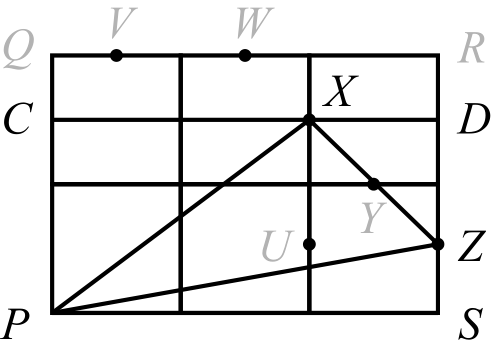
The area of is determined by subtracting the areas of triangles , and from the area of rectangle .
Since and , then the area of rectangle is .
Since and , then the area of is .
Since and , then the area of is .
Since and , then the area of is .
Therefore, the area of is .
Construct and notice that it is contained within square , as shown.
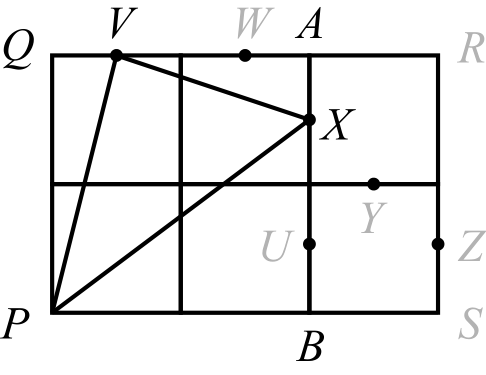
The area of is determined by subtracting the areas of triangles , and from the area of square .
As we previously determined, the area of square is and the area of is .
Since and , then the area of is .
Since and , then the area of is .
Therefore, the area of is .
Construct and the perpendicular from to on , as shown.
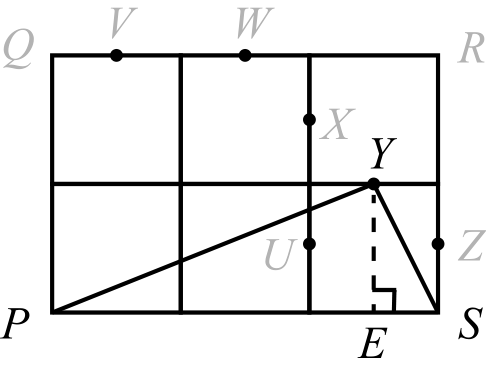
Since and ( is parallel to and thus equal in length to the side of the square), then the area of is .
Construct , as shown.
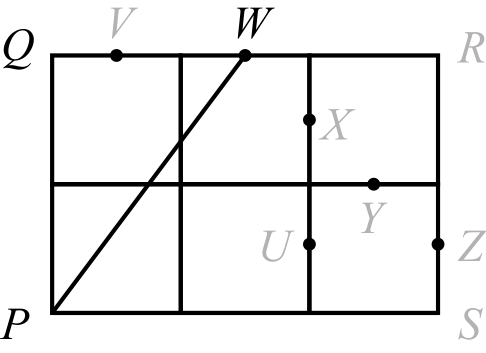
Since and , then the area of is .
The areas of the 5 triangles are and 24. The triangle with greatest area, 30, is .
Want a route through all this instead of an archive? The track
puts 2,604 problems in a working order, from Junior Challenge level to the IMO shortlist.