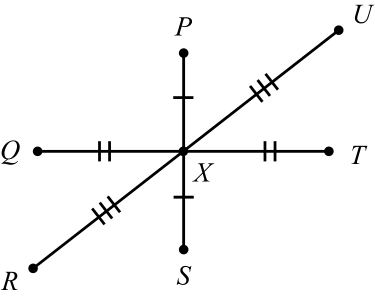
Bus A takes 12 minutes to complete one round trip that begins and ends at P.
Since PX=XS, it takes Bus A 12÷4=3 minutes to travel from P to X, 6 minutes to travel from X to S to X (3 minutes from X to S and 3 minutes from S to X), and 6 minutes to travel from X to P to X.
That is, Bus A first arrives at X at 1:03 and then continues to return to X every 6 minutes.
We write times that Bus A arrives at X in the table below.
| Bus A | 1:03 | 1:09 | 1:15 | 1:21 | 1:27 | 1:33 | 1:39 | 1:45 | 1:51 | 1:57 | 2:03 |
|---|---|---|---|---|---|---|---|---|---|---|---|
Notice that Bus A arrives at X at 1:03 and exactly one hour later at 2:03.
This makes sense since Bus A returns to X every 6 minutes and 60 minutes (one hour) is divisible by 6.
This tells us that Bus A will continue to arrive at the same number of minutes past each hour, or 2:03, 2:09, 2:15, …, 3:03, 3:09, …, 5:03, 5:09, …, 9:03, 9:09, …, 9:51, 9:57.
Bus B takes 20 minutes to complete one round trip that begins and ends at Q.
Since QX=XT, it takes Bus B 420=5 minutes to travel from Q to X, 10 minutes to travel from X to T to X (5 minutes from X to T and 5 minutes from T to X), and 10 minutes to travel from X to Q to X.
That is, Bus B first arrives at X at 1:05 and then continues to return to X every 10 minutes.
We write times that Bus B arrives at X in the table below.
| Bus B | 1:05 | 1:15 | 1:25 | 1:35 | 1:45 | 1:55 | 2:05 |
|---|---|---|---|---|---|---|---|
Notice that Bus B arrives at X at 1:05 and exactly one hour later at 2:05.
This makes sense since Bus B returns to X every 10 minutes and 60 minutes (one hour) is divisible by 10.
This tells us that Bus B will continue to arrive at the same number of minutes past each hour, or 2:05, 2:15, 2:25, …, 3:05, 3:15, …, 5:05, 5:15, …, 9:05, 9:15, …, 9:45, 9:55.
From the two tables above, we see that Bus A and Bus B both arrive at X at 15 minutes and 45 minutes past each hour.
Thus between 5:00 p.m. and 10:00 p.m., these two buses will meet 2×5=10 times at X.
These times are: 5:15, 5:45, 6:15, 6:45, 7:15, 7:45, 8:15, 8:45, 9:15, and 9:45.
Bus C takes 28 minutes to complete one round trip that begins and ends at R.
Since RX=XU, it takes Bus C 428=7 minutes to travel from R to X, 2×7=14 minutes to travel from X to U to X, and 14 minutes to travel from X to R to X.
That is, Bus C first arrives at X at 1:07 and then continues to return to X every 14 minutes.
Unlike Bus A and Bus B, Bus C will not arrive at X at consistent times past each hour since 60 is not divisible by 14.
What is the first time after 5:00 p.m. that Bus C arrives at X?
Since 238 is a multiple of 14 (14×17=238), Bus C will arrive at X 238 minutes after first arriving at X at 1:07 p.m.
Since 238 minutes is 2 minutes less than 4 hours (4×60=240), Bus C will arrive at X at 5:05 p.m. (This is the first time after 5:00 p.m. that Bus C arrives at X.)
Bus B also arrives at X at 5:05 p.m.
Are there other times after 5:05 p.m. (and before 10:00 p.m.) that Bus B and Bus C arrive at X at the same time?
Bus B arrives at X every 10 minutes and Bus C arrives at X every 14 minutes.
Since the lowest common multiple of 10 and 14 is 70, then Bus B and Bus C will each arrive at X every 70 minutes after 5:05 p.m., or at 6:15 p.m., 7:25 p.m., 8:35 p.m., and at 9:45 p.m.
Next we determine if there are times when Bus A and Bus C arrive at X at the same time.
Bus C arrives at X every 14 minutes after 5:05 p.m., or 5:19 p.m., 5:33 p.m., and so on.
Bus A also arrives at X at 5:33 p.m.
Are there other times after 5:33 p.m. (and before 10:00 p.m.) that Bus A and Bus C arrive at X at the same time?
Bus A arrives at X every 6 minutes and Bus C arrives at X every 14 minutes.
Since the lowest common multiple of 6 and 14 is 42, then Bus A and Bus C will each arrive at X every 42 minutes after 5:33 p.m., or at 6:15 p.m., 6:57 p.m., 7:39 p.m., 8:21 p.m., 9:03 p.m., and at 9:45 p.m.
The times when each pair of buses meet at X at the same time between 5:00 p.m. and 10:00 p.m. are listed below.
Bus A and Bus B: 15 and 45 minutes past each hour
Bus B and Bus C: 5:05 p.m., 6:15 p.m., 7:25 p.m., 8:35 p.m., 9:45 p.m.
Bus A and Bus C: 5:33 p.m., 6:15 p.m., 6:57 p.m., 7:39 p.m., 8:21 p.m., 9:03 p.m., 9:45 p.m.
Finally, we determine the number of different times that two or more buses arrive at X at the same time.
Bus A and Bus B arrive at X at 10 different times.
Bus B and Bus C arrive at X at 5 different times; however 2 of these times (6:15 p.m. and 9:45 p.m.) have already been counted, so there are 3 new times.
Bus A and Bus C arrive at X at 7 different times; however 2 of these times (6:15 p.m. and 9:45 p.m.) have already been counted, so there are 5 new times.
The number of times that two or more buses arrive at X between 5:00 p.m. and 10:00 p.m. is 10+3+5=18.