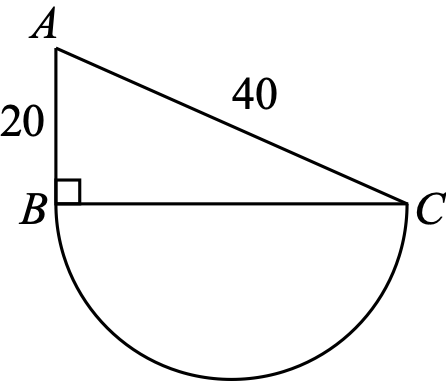
In the diagram, △ABC is right-angled at B and the semi-circle has diameter BC. If AB=20 and AC=40, what is the area of the semi-circle?
Pick one
Solution
△ABC is right-angled at B, and so by the Pythagorean Theorem, we get BC2=AC2−AB2 or BC2=402−202=1600−400=1200, and so BC=1200 (since BC gt;0).
The radius of the semi-circle is 21BC=21200, and so its area is 21π(21200)2=21π(41200), which when simplified is 21π(300)=150π.
Want a route through all this instead of an archive? The track
puts 2,604 problems in a working order, from Junior Challenge level to the IMO shortlist.