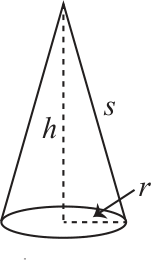
The total surface area of the cone includes the circular base and the lateral surface.
For the given unpainted cone, the base has area r 2 = (3 cm ) 2 = 9 cm 2 and the lateral surface has area rs = (3 cm )(5 cm ) = 15 cm 2.
Thus, the total surface area of the unpainted cone is 9 cm 2 + 15 cm 2 = 24 cm 2.
Since the height and base are perpendicular, the lengths s, h and r form a right-angled triangle with hypotenuse s.
For this cone, by the Pythagorean Theorem, h 2 = s 2 - r 2 = (5 cm ) 2 - (3 cm ) 2 = 16 cm 2 and so h = 4 cm.
When the unpainted cone is placed in the container of paint so that the paint rises to a depth of 2 cm, the base of the cone (area 9 cm 2) is covered in paint.
Also, the bottom portion of the lateral surface is covered in paint.
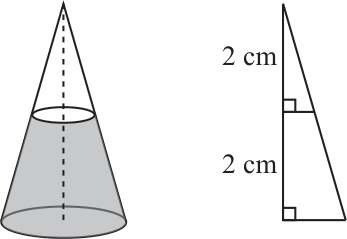
The unpainted portion of the cone is itself a cone with height 2.
When we take a vertical cross-section of the cone through its top vertex and a diameter of the base, the triangle formed above the paint is similar to the original triangle and has half its dimensions. The triangles are similar because both are right-angled and they share an equal angle at the top vertex. The ratio is 2:1 since their heights are 4 cm and 2 cm.
Therefore, the unpainted cone has radius 1.5 cm (half of the original radius of 3 cm) and slant height 2.5 cm (half of the original slant height of 5 cm).
Thus, the unpainted lateral surface area is the lateral surface area of a cone with radius 1.5 cm and slant height 2.5 cm, and so has area (1.5 cm )(2.5 cm ) = 3.75 cm 2.
This means that the painted lateral surface area is 15 cm 2 - 3.75 cm 2 = 11.25 cm 2. (This is in fact three-quarters of the total surface area. Can you explain why this is true in a different way?)
Thus, the fraction of the total surface area of the cone that is painted is 9 cm 2 + 11.25 cm 2 24 cm 2 = 20.25 24 = 81 96 = 27 32 Since 3227 is in lowest terms, then p+q=27+32=59.