A rectangle with height
cm and width cm is painted with
vertical strips and horizontal strips. Each vertical strip
has height cm and width cm. Each horizontal strip has height
cm and width cm. Each vertical strip overlaps each
horizontal strip. Vertical strips do not overlap one another, and
horizontal strips do not overlap one another. The area of the painted
portion of the rectangle is of the area of the
rectangle. What is the value of ?
CEMC Fermat, 2026
Solution
Solution 1:
The total area of the vertical strips is .
The total area of the horizontal strips is .
Each horizontal strip overlaps with each vertical strip in a rectangle.
Each rectangle formed by an overlap has the same height as a horizontal
strip and the same width as a vertical strip. Therefore, each
overlapping rectangle has area .
There are
overlaps in total, and each overlap is included in both the total area
of the horizontal strips and the total area of the vertical
strips.
Therefore, the total painted area is . We are given that this is equal to
of the total area of
the rectangle, or .
The integer satisfies the
equation , which
is equivalent to .
Factoring gives , so
the possible values of are and . However, if , then the horizontal strips would
cover a height of . Since the rectangle has a height of , and the horizontal strips
do not overlap, this is impossible.
The only possible value of is
.
Solution 2:
Shifting a horizontal strip up or down, will not change the total
amount of the rectangle that is painted, as long as this shifting does
not introduce overlap between horizontal strips. Similarly, shifting
vertical strips to the left or right does not change the amount of the
rectangle that is painted, as long as the shifting does not introduce
overlap between vertical strips.
Because of this, we can assume without loss of generality
that the horizontal strips are all at the top of the rectangle and
exactly touching each other without overlap. We can also assume that the
vertical strips are all at the left of the grid touching each other
without overlap. This configuration is shown in the diagram.
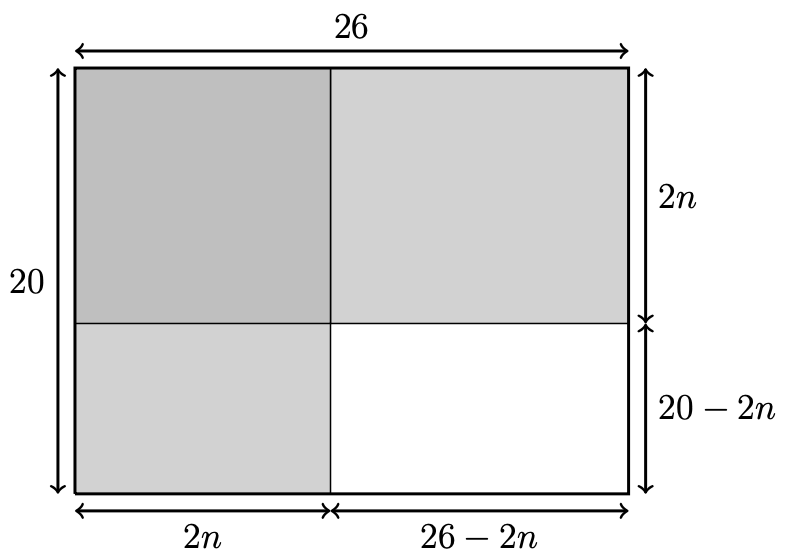
The unpainted portion is a rectangle with width and height . We are also given that the area of
the painted portion is of the area of the rectangle, so the area of the
unpainted portion must be of .
Therefore, we have . Expanding the left side
gives ,
which can be rearranged to get .
Proceeding as in Solution 1, the only solution to this equation that
makes sense given the context is .
Want a route through all this instead of an archive? The track
puts 2,604 problems in a working order, from Junior Challenge level to the IMO shortlist.