Arun and Bella run around a circular track, starting from diametrically opposite points. Arun runs clockwise around the track and Bella runs counterclockwise. Arun and Bella run at constant, but different, speeds. They meet for the first time after Arun has run 100 m. They meet for the second time after Bella runs 150 m past their first meeting point. What is the length of the track? Determine all angles θ with 0°≤θ≤360° for which 41+cos3θ=22−cosθ⋅8cos2θ.
Solution
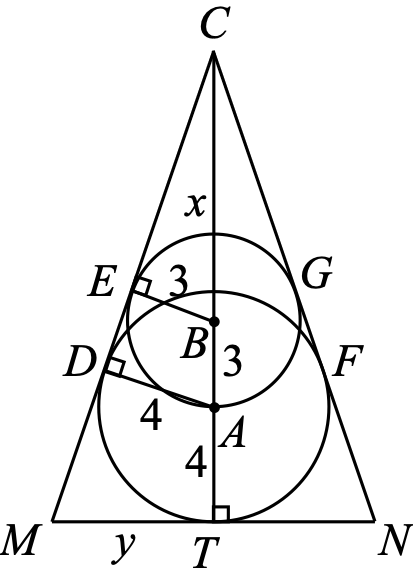
We join B to E and A to D.
Since MC is tangent to the circles with centres A and B at D and E, respectively, then AD and BE are perpendicular to MC.
Since the radius of the circle with centre B is 3, then AB=3 and BE=3.
Since the radius of the circle with centre A is 4, then AD=4 and AT=4.
Let CB=x and MT=y.
We note that △CEB, △CDA and △CTM are all similar, since they are right-angled at E, D and T, respectively, and share a common angle at C.
Since △CEB and △CDA are similar, then CACB=ADBE and so x+3x=43 which gives 4x=3x+9 and so x=9.
By the Pythagorean Theorem, CE=CB2−BE2=92−32=72=62.
Since △CEB and △CTM are similar, then CEBE=CTMT and so 623=9+3+4y which gives y=6216⋅3=28=42.
Finally, the area of △MNC is equal to 21⋅MN⋅CT.
If we joined B to G, we would see that △CEB is congruent to △CGB (each is right-angled, they have a common hypotenuse, and BE=BG). This means that ∠BCE=∠BCG, which in turn means that MT=TN.
Since MT=TN, then MN=2⋅42=82 and so the area of △MNC is 21⋅82⋅16 or 642. First, we note that log3z=log103log10z=2log1032log10z=log10(32)log10(z2)=log109log10(z2)=log9(z2) Similarly, log4y=log16(y2) and log5x=log25(x2).
We also note from the original system of equations that x gt; 0 and y gt; 0 and z gt; 0.
Therefore, we can re-write the original system of equations as log9x+log9y+log9(z2)log16x+log16(y2)+log16zlog25(x2)+log25y+log25zamp;=2amp;=1amp;=0 Using logarithm rules, this is equivalent to the system log9(xyz2)log16(xy2z)log25(x2yz)amp;=2amp;=1amp;=0 and to the system xyz2xy2zx2yzamp;=92=81amp;=161=16amp;=250=1 Multiplying these three equations together, we obtain x4y4z4=1296 and so (xyz)4=64.
Thus, xyz=6.
Since xyz2=81 and xyz=6, then z=xyzxyz2=681=227.
Similarly, y=xyzxy2z=616=38 and x=xyzx2yz=61.
Therefore, (x,y,z)=(61,38,227).
We can check by substitution that this triple does satisfy the original system of equations.
Want a route through all this instead of an archive? The track
puts 2,604 problems in a working order, from Junior Challenge level to the IMO shortlist.