In the grid shown, six of the squares are not intersected by either diagonal.
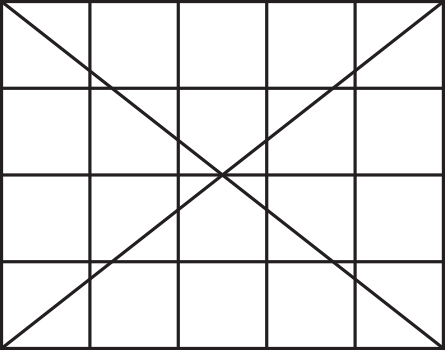
When the two diagonals of an grid are drawn, how many of the squares are not intersected by either diagonal?
In the grid shown, six of the squares are not intersected by either diagonal.
When the two diagonals of an grid are drawn, how many of the squares are not intersected by either diagonal?
If we remove one diagonal from the given grid, we see that 8 squares are intersected by the remaining diagonal and 12 squares are not intersected.
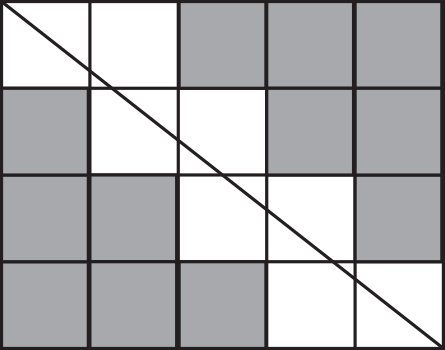
The result is the same whichever of the two diagonals is removed.
We can construct an grid with two diagonals by combining four such grids:
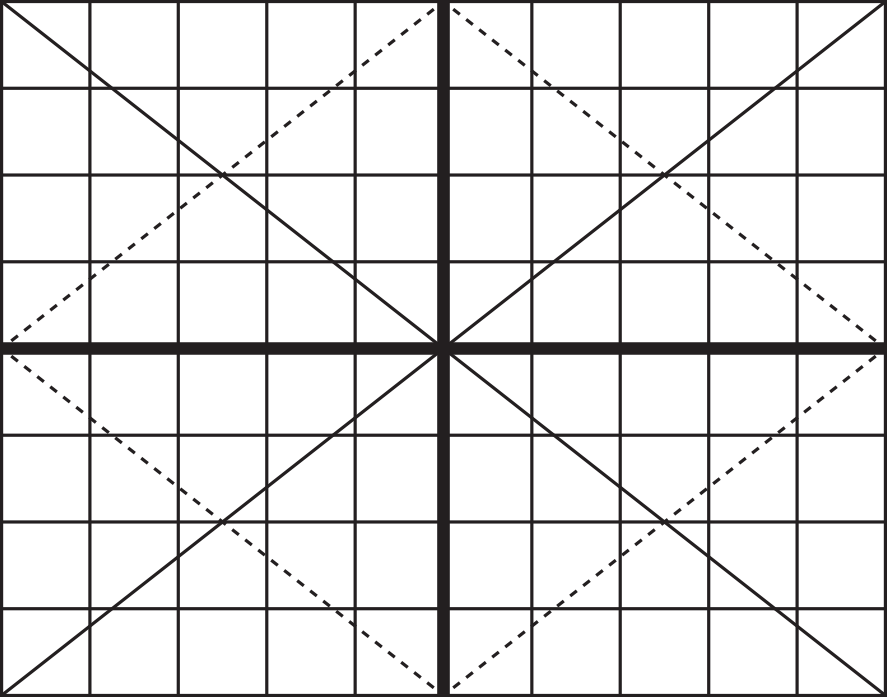
When these four pieces are joined together, the diagonals of the pieces join to form the diagonal of the large rectangle because their slopes are the same.
In each of the four pieces, 12 of the squares are not intersected by either diagonal.
Overall, this means that of the squares are not intersected by either diagonal.