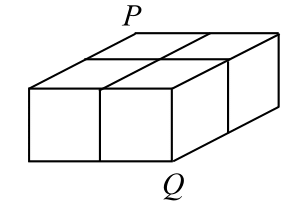
We label the remaining points on the diagram as shown.
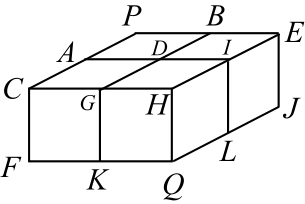
There is exactly one path that the squirrel can take to get to each of A, C, F, B, E, and J.
For example, to get to F the squirrel must walk from P to A to C to F.
The number of paths that the squirrel can take to point D is 2, since there is 1 path to each of A and B, and to get to D, the squirrel must go through exactly one of A or B.
Similarly, the number of paths to G is the sum of the number of paths to C and to D (that is, 1+2=3), because for the squirrel to get to G, it must walk through exactly one of C or D.
Using this process, we add to the diagram the number of paths to reach each of H, I, K, and L.
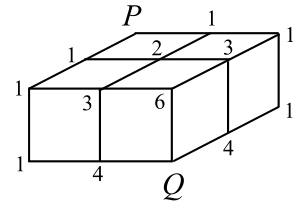
Finally, to get to Q, the squirrel must go through exactly one of H, K, or L, so the number of paths to Q is 6+4+4=14.