Two boats, The Luna and The Tuna, leave from the same dock at the
same time. The Luna travels northwest at km/h for hour and then stops. The Tuna travels
northeast at km/h for hour, then turns north and continues
travelling north for minutes at
km/h before stopping. To the
nearest kilometre, what is the distance between the boats?
CEMC Cayley, 2026
Pick one
Solution
Let be the point from
which the two boats begin, let be
the point that The Luna reaches after the first hour, let be the point that The Tuna reaches
after the first hour, and let be
the point that The Tuna reaches after it travels north for minutes from .
The Luna travels from to in hour at a speed of , so the length of is .
The Tuna travels from to in hour at a speed of , so the length of is .
The Tuna travels from to in minutes or hours at a speed of km/h, so the length of is .
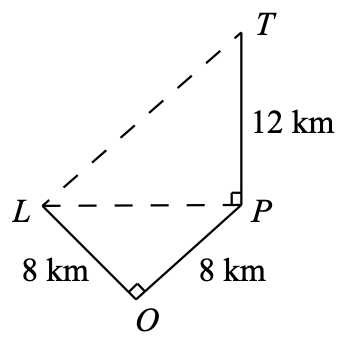
The direction from to is northwest, and the direction from
to is northeast. Each of these directions
are from north, and so we
conclude that .
In the first hour, The Luna and The Tuna each traveled the same
distance at an angle of
from north, and so the two boats were at exactly the same latitude when
they reached points and , respectively. Put differently, The
Tuna was directly east of The Luna after the first hour. Since The Tuna
then travels north, we conclude that .
We have that is
right-angled at and is right-angled at .
By the Pythagorean theorem, we get and .
Substituting the expression for from the first of these equations
into the second, and using the lengths calculated above, we have Since , we have . To the nearest
kilometre, the distance between the two boats is .
Want a route through all this instead of an archive? The track
puts 2,604 problems in a working order, from Junior Challenge level to the IMO shortlist.