The area of the triangular region bounded by the -axis, the -axis and the line with equation is one-quarter of the area of
the triangular region bounded by the -axis, the line with equation and the line with equation
, where . What is the value of ?
CEMC Cayley, 2022
Pick one
Solution
The line with equation has -intercept .
Also, the -intercept of occurs when , which gives or which gives .
Therefore, the triangle bounded by the -axis, the -axis, and the line with equation has base of length 3 and
height of length 6, and so has area .
We want the area of the triangle bounded by the -axis, the vertical line with equation
, and the line with equation
to be 4 times this area,
or 36.
This means that is to the right
of the point , because the new
area is larger. In other words, .
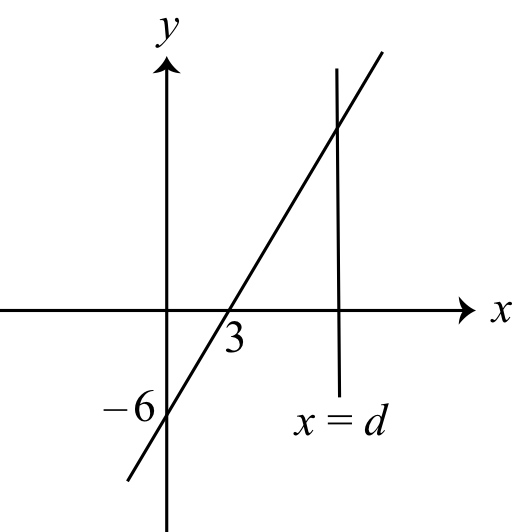
The base of this triangle has length , and its height is , since the height is measured along
the vertical line with equation .
Thus, we want or
which means .
Since , then which gives .
Alternatively, we could note that if similar triangles have areas in the
ratio then their corresponding
lengths are in the ratio
or .
Since the two triangles in question are similar (both are right-angled
and they have equal angles at the point ), the larger triangle has base of
length and so .
Want a route through all this instead of an archive? The track
puts 2,604 problems in a working order, from Junior Challenge level to the IMO shortlist.