Maths Olympiad Prep

Library / /440 of 482

, 2026

Geometry Difficulty 3.3 AMC 10/12 Find the answer Canada

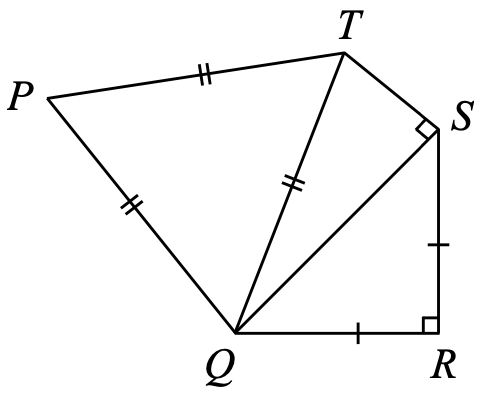
In the diagram, PQT\triangle PQT is equilateral. Both QST\triangle QST and QRS\triangle QRS are right-angled triangles and QR=RSQR=RS.Figure 0If STP=120°\angle STP=120\degree, the measure of PQR\angle PQR is

Pick one

Solution

Each angle in an equilateral triangle measures 60°60\degree, and so PQT=QTP=60°\angle PQT=\angle QTP=60\degree. Since STP=120°\angle STP=120\degree, then STQ=120°QTP=120°60°=60°\angle STQ=120\degree-\angle QTP= 120\degree-60\degree=60\degree. The sum of the three angles in
QST\triangle QST is 180°180\degree, and so TQS=180°90°60°=30°\angle TQS=180\degree-90\degree-60\degree=30\degree.

In QRS\triangle QRS, QR=RSQR=RS and so QSR=SQR=180°90°2=90°2=45°\angle QSR=\angle SQR=\dfrac{180\degree-90\degree}{2}=\dfrac{90\degree}{2}=45\degree.

The measure of PQR\angle PQR is equal to $PQT+TQS+SQR=60°+30°+45°=135°$.\$\angle PQT+\angle TQS+\angle SQR=60\degree+30\degree+45\degree=135\degree\$.

Figure for this problem

Want a route through all this instead of an archive? The track puts 2,604 problems in a working order, from Junior Challenge level to the IMO shortlist.
Source: CEMC, University of Waterloo, licensed CC-BY-NC-4.0. Statement reproduced verbatim; metadata (topic, difficulty) added by this project.