Solution 1
Among a group of n people, there are 2n(n−1) ways of choosing a pair of these people:
There are n people that can be chosen first.
For each of these n people, there are n−1 people that can be chosen second.
This gives n(n−1) orderings of two people.
Each pair is counted twice (given two people A and B, we have counted both the pair AB and the pair BA), so the total number of pairs is 2n(n−1).
We label the four canoes W, X, Y, and Z.
First, we determine the total number of ways to put the 8 people in the 4 canoes.
We choose 2 people to put in W. There are 28⋅7 pairs. This leaves 6 people for the remaining 3 canoes.
Next, we choose 2 people to put in X. There are 26⋅5 pairs. This leaves 4 people for the remaining 2 canoes.
Next, we choose 2 people to put in Y. There are 24⋅3 pairs. This leaves 2 people for the remaining canoe.
There is now 1 way to put the remaining people in Z.
Therefore, there are 28⋅7⋅26⋅5⋅24⋅3=238⋅7⋅6⋅5⋅4⋅3=7⋅6⋅5⋅4⋅3 ways to put the 8 people in the 4 canoes.
Now, we determine the number of ways in which no two of Barry, Carrie and Mary will be in the same canoe.
There are 4 possible canoes in which Barry can go.
There are then 3 possible canoes in which Carrie can go, because she cannot go in the same canoe as Barry.
There are then 2 possible canoes in which Mary can go, because she cannot go in the same canoe as Barry or Carrie.
This leaves 5 people left to put in the canoes.
There are 5 choices of the person that can go with Barry, and then 4 choices of the person that can go with Carrie, and then 3 choices of the person that can go with Mary.
The remaining 2 people are put in the remaining empty canoe.
This means that there are 4⋅3⋅2⋅5⋅4⋅3 ways in which the 8 people can be put in 4 canoes so that no two of Barry, Carrie and Mary are in the same canoe.
Therefore, the probability that no two of Barry, Carrie and Mary are in the same canoe is 7⋅6⋅5⋅4⋅34⋅3⋅2⋅5⋅4⋅3=7⋅64⋅3⋅2=4224=74.
Solution 2
Let p be the probability that two of Barry, Carrie and Mary are in the same canoe.
The answer to the original problem will be 1−p.
Let q be the probability that Barry and Carrie are in the same canoe.
By symmetry, the probability that Barry and Mary are in the same canoe also equals q as does the probability that Carrie and Mary are in the same canoe.
This means that p=3q.
So we calculate q.
To do this, we put Barry in a canoe. Since there are 7 possible people who can go in the canoe with him, then the probability that Carrie is in the canoe with him equals 71. The other 6 people can be put in the canoes in any way.
This means that the probability that Barry and Carrie are in the same canoe is q=71.
Therefore, the probability that no two of Barry, Carrie and Mary are in the same canoe is 1−3⋅71 or 74.
Solution 1
Consider square WXYZ in the first quadrant. Suppose that WY makes an angle of θ with the horizontal.
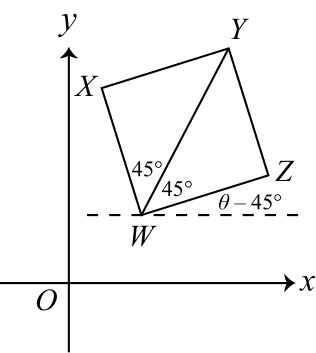
Since the slope of WY is 2, then tanθ=2, since the tangent of an angle equals the slope of a line that makes this angle with the horizontal.
Since = 2 gt; 1 = 45, then gt; 45.
Now WY bisects ∠ZWX, which is a right-angle.
Therefore, ∠ZWY=∠YWX=45∘.
Therefore, WX makes an angle of θ+45∘ with the horizontal and WZ makes an angle of θ−45∘ with the horizontal. Since gt; 45, then - 45 gt; 0 and + 45 gt; 90.
We note that since WZ and XY are parallel, then the slope of XY equals the slope of WZ.
To calculate the slopes of WX and WZ, we can calculate tan(θ+45∘) and tan(θ−45∘).
Using the facts that tan(A+B)=1−tanAtanBtanA+tanB and tan(A−B)=1+tanAtanBtanA−tanB, we obtain: tan(θ+45∘)tan(θ−45∘)amp;=1−tanθtan45∘tanθ+tan45∘=1−(2)(1)2+1=−3amp;=1−tanθtan45∘tanθ−tan45∘=1+(2)(1)2−1=31 Therefore, the sum of the slopes of WX and XY is −3+31=−38.
Solution 2
Consider a square WXYZ whose diagonal WY has slope 2.
Translate this square so that W is at the origin (0,0). Translating a shape in the plane does not affect the slopes of any line segments.
Let the coordinates of Y be (2a,2b) for some non-zero numbers a and b.
Since the slope of WY is 2, then 2a−02b−0=2 and so 2b=4a or b=2a.
Thus, the coordinates of Y can be written as (2a,4a).
Let C be the centre of square WXYZ.
Then C is the midpoint of WY, so C has coordinates (a,2a).
We find the slopes of WX and XY by finding the coordinates of X.
Consider the segment XC.
Since the diagonals of a square are perpendicular, then XC is perpendicular to WC.
Since the slope of WC is 2, then the slopes of XC and ZC are −21.
Since the diagonals of a square are equal in length and C is the midpoint of both diagonals, then XC=WC.
Since WC and XC are perpendicular and equal in length, then the “rise/run triangle” above XC will be a 90∘ rotation of the “rise/run triangle” below WC.
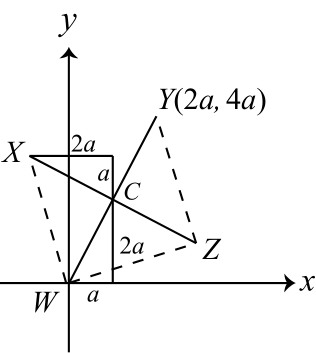
This is because these triangles are congruent (each is right-angled, their hypotenuses are of equal length, and their remaining angles are equal) and their hypotenuses are perpendicular.
In this diagram, we have assumed that X is to the left of W and Z is to the right of W. Since the slopes of parallel sides are equal, it does not matter which vertex is labelled X and which is labelled Z. We would obtain the same two slopes, but in a different order.
To get from W(0,0) to C(a,2a), we go up 2a and right a.
Thus, to get from C(a,2a) to X, we go left 2a and up a.
Therefore, the coordinates of X are (a−2a,2a+a) or (−a,3a).
Thus, the slope of WX is −a−03a−0=−3.
Since XY is perpendicular to WX, then its slope is the negative reciprocal of −3, which is 31.
The sum of the slopes of WX and XY is −3+31=−38.