Maths Olympiad Prep

Library / /183 of 187

, 2022

Algebra Difficulty 4.2 AIME Prove it Canada

A computer is programmed to choose an integer between 1
and 99, inclusive, so that the probability that it selects the integer
xx is equal to log100(1+1x)\log_{100}\left(1+\dfrac{1}{x}\right).
Suppose that the probability that 81x9981 \leq x \leq 99 is equal to 2 times the probability that x=nx = n for some integer nn. What is the value of nn?
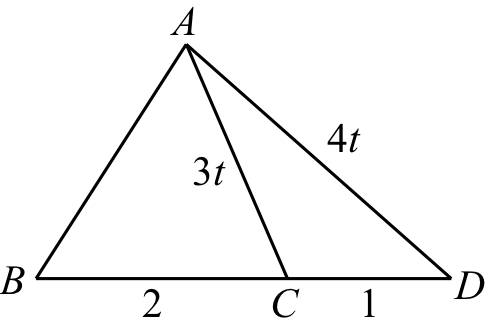
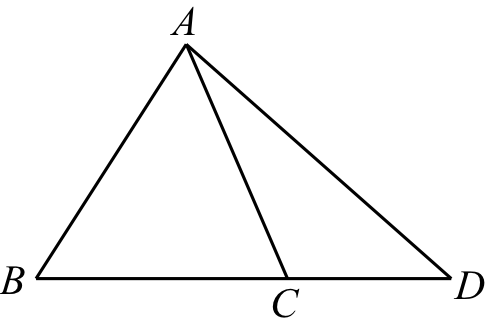
In the diagram, ABD\triangle ABD has CC on BDBD. Also, BC=2BC=2, CD=1CD=1, ACAD=34\dfrac{AC}{AD} = \dfrac{3}{4}, and cos(ACD)=35\cos(\angle ACD) = -\dfrac{3}{5}.
Determine the length of ABAB.

Figure 0

Figure for this problem

Solution

The probability that the integer nn is chosen is log100(1+1n)\log_{100}\left(1 + \dfrac{1}{n}\right).

The probability that an integer between 81 and 99, inclusive, is chosen
equals the sum of the probabilities that the integers 81, 82, \ldots, 98, 99 are selected, which equals
log100(1+181)+log100(1+182)++log100(1+198)+log100(1+199)\log_{100}\left(1 + \dfrac{1}{81}\right) + \log_{100}\left(1 + \dfrac{1}{82}\right) + \cdots + \log_{100}\left(1 + \dfrac{1}{98}\right) + \log_{100}\left(1 + \dfrac{1}{99}\right)
Since the second probability equals 2 times the first probability, the
following equations are equivalent: log100(1+181)+log100(1+182)++log100(1+198)+log100(1+199)amp;=2log100(1+1n)log100(8281)+log100(8382)++log100(9998)+log100(10099)amp;=2log100(1+1n)\begin{aligned} \hspace{-2cm} \log_{100}\left(1 + \dfrac{1}{81}\right) + \log_{100}\left(1 + \dfrac{1}{82}\right) + \cdots + \log_{100}\left(1 + \dfrac{1}{98}\right) + \log_{100}\left(1 + \dfrac{1}{99}\right) & = 2\log_{100}\left(1 + \dfrac{1}{n}\right) \\ \log_{100}\left(\dfrac{82}{81}\right) + \log_{100}\left(\dfrac{83}{82}\right) + \cdots + \log_{100}\left(\dfrac{99}{98}\right) + \log_{100}\left(\dfrac{100}{99}\right) & = 2\log_{100}\left(1 + \dfrac{1}{n}\right)\end{aligned}
Using logarithm laws, these equations are further equivalent to log100(82818382999810099)amp;=log100(1+1n)2log100(10081)amp;=log100(1+1n)2\begin{aligned} \log_{100}\left(\dfrac{82}{81} \cdot \dfrac{83}{82}\cdot \cdots \cdot \dfrac{99}{98} \cdot \dfrac{100}{99}\right) & = \log_{100}\left(1 + \dfrac{1}{n}\right)^2 \\ \log_{100}\left(\dfrac{100}{81}\right) & = \log_{100}\left(1 + \dfrac{1}{n}\right)^2\end{aligned} Since logarithm functions
are invertible, we obtain 10081=(1+1n)2\dfrac{100}{81} = \left(1 + \dfrac{1}{n}\right)^2.

Since n gt;0\text{n gt;0}, then 1+1n=10081=1091 + \dfrac{1}{n} = \sqrt{\dfrac{100}{81}} = \dfrac{10}{9}, and so 1n=19\dfrac{1}{n} = \dfrac{1}{9}, which gives n=9n = 9.
Since ACAD=34\dfrac{AC}{AD} = \dfrac{3}{4}, then we let AC=3tAC = 3t and AD=4tAD = 4t for some
real number t gt; 0\text{t gt; 0}.

Figure 1

Using the cosine law in ACD\triangle ACD, the following equations are equivalent: AD2amp;=AC2+CD22ACCDcos(ACD)(4t)2amp;=(3t)2+122(3t)(1)(35)16t2amp;=9t2+1+185t80t2amp;=45t2+5+18t35t218t5amp;=0(7t5)(5t+1)amp;=0\begin{aligned} AD^2 & = AC^2 + CD^2 - 2 \cdot AC \cdot CD \cdot \cos(\angle ACD) \\ (4t)^2 & = (3t)^2 + 1^2 - 2(3t)(1)(-\tfrac{3}{5}) \\ 16t^2 & = 9t^2 + 1 + \tfrac{18}{5}t \\ 80t^2 & = 45t^2 + 5 + 18t \\ 35t^2 - 18t - 5 & = 0 \\ (7t-5)(5t + 1) & = 0\end{aligned} Since t gt; 0\text{t gt; 0}, then t=57t = \frac{5}{7}.

Thus, AC=3t=157AC = 3t = \frac{15}{7}.

Using the cosine law in ACB\triangle ACB and noting that cos(ACB)=cos(180ACD)=cos(ACD)=35\cos(\angle ACB) = \cos(180^\circ - \angle ACD) = -\cos(\angle ACD) = \tfrac{3}{5} the following equations are equivalent: AB2amp;=AC2+BC22ACBCcos(ACB)amp;=(157)2+222(157)(2)(35)amp;=22549+4367amp;=22549+1964925249amp;=16949\begin{aligned} AB^2 & = AC^2 + BC^2 - 2 \cdot AC \cdot BC \cdot \cos(\angle ACB) \\ & = \left(\tfrac{15}{7}\right)^2 + 2^2 - 2(\tfrac{15}{7})(2)(\tfrac{3}{5}) \\[1mm] & = \tfrac{225}{49} + 4 - \tfrac{36}{7} \\[1mm] & = \tfrac{225}{49} + \tfrac{196}{49} - \tfrac{252}{49} \\[1mm] & = \tfrac{169}{49}\end{aligned} Since AB gt;0\text{AB gt;0}, then AB=137AB = \frac{13}{7}.

Figure for this problem

Want a route through all this instead of an archive? The track puts 2,604 problems in a working order, from Junior Challenge level to the IMO shortlist.
Source: CEMC, University of Waterloo, licensed CC-BY-NC-4.0. Statement reproduced verbatim; metadata (topic, difficulty) added by this project.