We can represent the given information in a Venn diagram by first
introducing some variables.
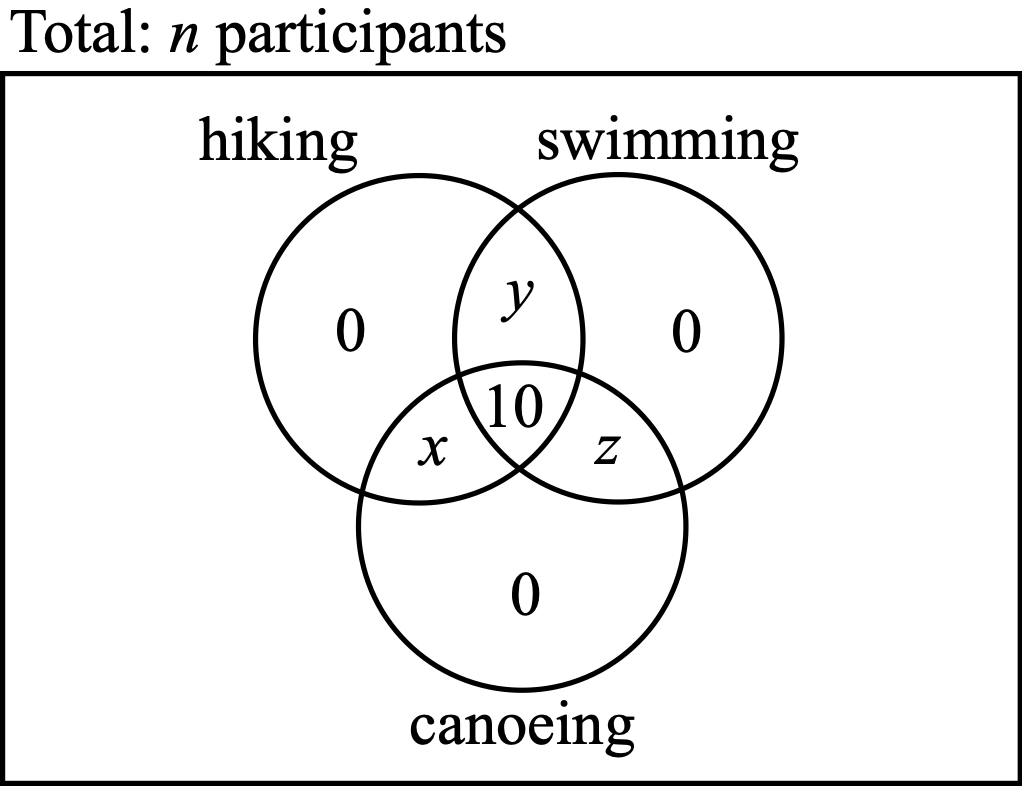
Let x be the number of students
that participated in hiking and canoeing, but not swimming.
Let y be the number of students
that participated in hiking and swimming, but not canoeing.
Let z be the number of students
that participated in canoeing and swimming, but not hiking.
Since 10 students participated in all three activities and no students
participated in fewer than two activities, we complete the Venn diagram
as shown.
Suppose that the total number of students participating in the school
trip was n.
Since 50% of all students participated in at least hiking and canoeing,
then 10050n or 2n participated in at least
hiking and canoeing.
Since this number of students, 2n, is an integer, then n must be divisible by 2.
Similarly, 10060n or
53n students participated
in at least hiking and swimming.
Since this number of students, 53n, is an integer, then n must be divisible by 5 (since 3 and 5
have no factors in common).
This means that n is divisible by
both 2 and 5, and thus n is
divisible by 10.
From the Venn diagram, we see that x+10=2n, and y+10=53n.
Since the total number of participants is n, we also get that x+y+z+10=n or z=n−10−x−y.
We may now use these equations, x=2n−10, y=53n−10, and z=n−10−x−y and the fact that n is divisible by 10, to determine all
possible values of z.
We can then use the values of z to
determine all possible values of the positive integer k, where k% participated in at least canoeing and
swimming.
Since n is a positive integer
that is divisible by 10, its smallest possible value is 10.
However, substituting n=10 into
x=2n−10, we get x=5−10 and so x=−5 which is not possible. (Recall that
x is the number of students that
participated in hiking and canoeing, but not swimming, and so x≥0.)
Next, we try n=20.
When n=20, x=10−10 and so x=0.
When n=20, y=53×20−10 or y=12−10, and so y=2.
Finally, when n=20, x=0, and y=2, we get z=20−10−0−2=8.
When z=8, the number of students
who participated in at least canoeing and swimming is 8+10=18 (since 10 students participated
in all three), and so the percentage of students who participated in at
least canoeing and swimming is 2018×100%=90%, and so
k=90.
In the table below, we continue in this way by using successively
greater multiples of 10 for the value of n.
For values of n that are greater
than 100, we get that z lt;0, which
is not possible.
Therefore, the sum of all such positive integers k is 90+40+30+15+10=185.