The quadratic function f(x)=x2+(2n−1)x+(n2−22) has no real roots exactly when its
discriminant, Δ, is
negative.
The discriminant of this function is Δamp;=(2n−1)2−4(1)(n2−22)amp;=(4n2−4n+1)−(4n2−88)amp;=−4n+89 We have lt; 0 exactly when -4n + 89 lt; 0 or 4n gt; 89.
This final inequality is equivalent to n gt; 89 4 = 22 1 4.
Therefore, the smallest positive integer that satisfies this inequality,
and hence for which f(x) has no
real roots, is n=23.
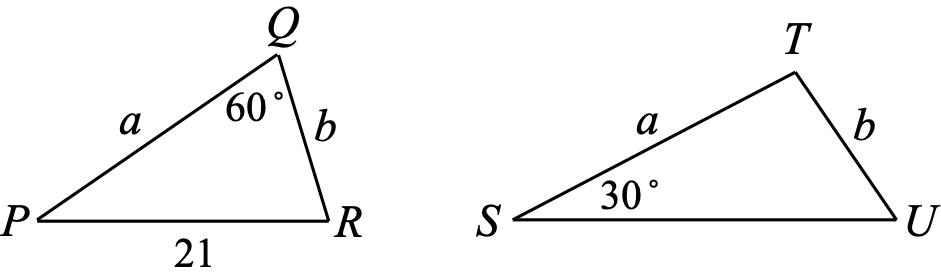
Using the cosine law in △PQR, PR2212441441amp;=PQ2+QR2−2⋅PQ⋅QR⋅cos(∠PQR)amp;=a2+b2−2abcos(60∘)amp;=a2+b2−2ab⋅21amp;=a2+b2−ab Using the sine law in
△STU, we obtain sin(∠TUS)ST=sin(∠TSU)TU and so 4/5a=sin(30∘)b.
Therefore, 4/5a=1/2b and so a=54⋅2b=58b.
Substituting into the previous equation, 441441441441225amp;=(58b)2+b2−(58b)bamp;=2564b2+b2−58b2amp;=2564b2+2525b2−2540b2amp;=2549b2amp;=b2 Since b gt; 0, then b=15 and so a=58b=58⋅15=24.