The perimeter of equilateral △PQR is 12. The perimeter of regular hexagon STUVWX is also 12. What is the ratio of the area of △PQR to the area of STUVWX?
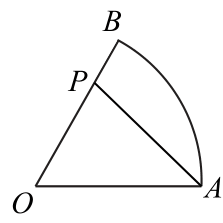
In the diagram, sector AOB is 61 of an entire circle with radius AO=BO=18. The sector is cut into two regions with a single straight cut through A and point P on OB. The areas of the two regions are equal. Determine the length of OP.
Solution
Since the hexagon has perimeter 12 and has 6 sides, then each side has length 2.
Since equilateral △PQR has perimeter 12, then its side length is 4.
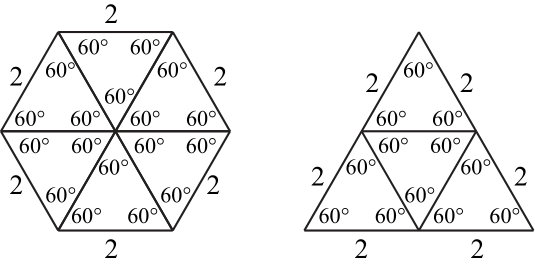
Consider equilateral triangles with side length 2.
Six of these triangles can be combined to form a regular hexagon with side length 2 and four of these can be combined to form an equilateral triangle with side length 4.
Note that the six equilateral triangles around the centre of the hexagon give a total central angle of 6⋅60∘=360∘ (a complete circle) and the three equilateral triangles along each side of the large equilateral triangle make a straight angle of 180∘ (since 3⋅60∘=180∘).
Also, the length of each side of the hexagon is 2 and the measure of each internal angle is 120∘, which means that the hexagon is regular. Similarly, the triangle is equilateral.
Since the triangle is made from four identical smaller triangles and the hexagon is made from six of these smaller triangles, the ratio of the area of the triangle to the hexagon is 4:6 which is equivalent to 2:3. Since sector AOB is 61 of a circle with radius 18, its area is 61(π⋅182) or 54π.
For the line AP to divide this sector into two pieces of equal area, each piece has area 21(54π) or 27π.
We determine the length of OP so that the area of △POA is 27π.
Since sector AOB is 61 of a circle, then ∠AOB=61(360∘)=60∘.
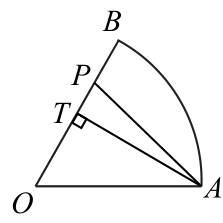
Drop a perpendicular from A to T on OB.
The area of △POA is 21(OP)(AT).
△AOT is a 30∘-60∘-90∘ triangle.
Since AO=18, then AT=23(AO)=93.
For the area of △POA to equal 27π, we have 21(OP)(93)=27π which gives OP=9354π=36π=23π.
(Alternatively, we could have used the fact that the area of △POA is 21(OA)(OP)sin(∠POA).)
Want a route through all this instead of an archive? The track
puts 2,604 problems in a working order, from Junior Challenge level to the IMO shortlist.