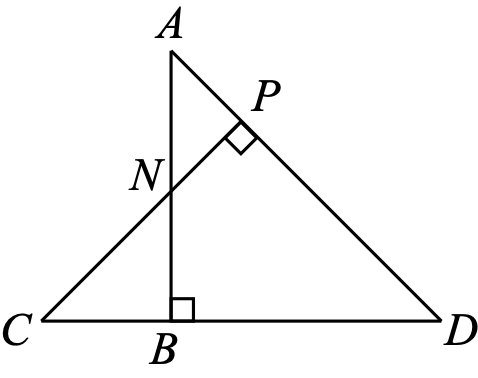
In the diagram, AB is perpendicular to CD (with B on CD), CP is perpendicular to AD (with P on AD), and N is the point of intersection of AB and CP.
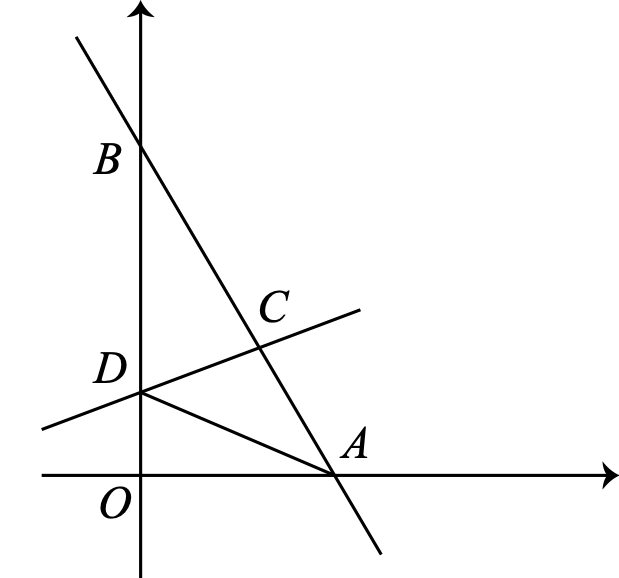
Also, ∠ADB=45°, AB=12, and CB=6. What is the area of △APN? In the diagram, the line with equation y=−3x+6 crosses the x-axis at A and the y-axis at B. Suppose that m gt;0 and that the line with equation y=mx+1 crosses the y-axis at D and intersects the line with equation y=−3x+6 at the point C.
If O is the origin and the area of △ACD is 21 of the area of △ABO, determine the coordinates of C.
Solution
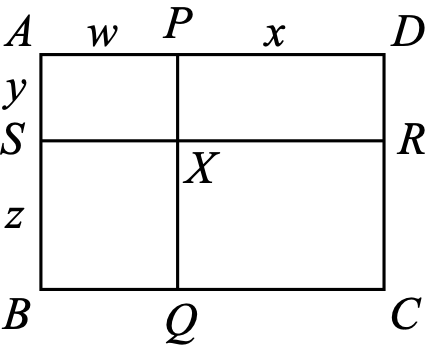
Suppose that AP=w, PD=x, AS=y, and SB=z.
We use the notation ∣APXS∣ to represent the area of APXS, and so on.
Thus, ∣APXS∣=wy, ∣PDRX∣=xy, ∣SXBQ∣=wz, and ∣XRCQ∣=xz.
Then, ∣APXS∣⋅∣XRCQ∣=wy⋅xz=xy⋅wz=∣PDRX∣⋅∣SXQB∣ If ∣APXS∣=2, ∣PDRX∣=3, and ∣SWQB∣=6, then a=∣XRQC∣=32⋅6=4.
If ∣APXS∣=2, ∣PDRX∣=6, and ∣SWQB∣=3, then a=∣XRQC∣=62⋅3=1.
If ∣APXS∣=6, ∣PDRX∣=2, and ∣SWQB∣=3, then a=∣XRQC∣=26⋅3=9.
Since we are told that there are three possible values for a, then these are 1, 4 and 9.
(Can you explain why there are exactly three such values?) The x-intercepts of the parabola with equation y=x2−4tx+5t2−6t are x=24t±(−4t)2−4(5t2−6t) The distance, d, between these intercepts is their difference, which is d=24t+(−4t)2−4(5t2−6t)−24t−(−4t)2−4(5t2−6t)=(−4t)2−4(5t2−6t) From this we see that d is as large as possible exactly when the discriminant is as large as possible. Here, the discriminant, Δ, is Δ=(−4t)2−4(5t2−6t)=16t2−20t2+24t=−4t2+24t Completing the square, Δ=−4(t2−6t)=−4(t2−6t+9−9)=−4(t2−6t+9)+36=−4(t−3)2+36 Since (t−3)2≥0, then Δ≤36 and Δ=36 exactly when (t−3)2=0 or t=3.
Therefore, the discriminant is maximized when t=3, which means that the distance between the x-intercepts is as large as possible when t=3.
Want a route through all this instead of an archive? The track
puts 2,604 problems in a working order, from Junior Challenge level to the IMO shortlist.