Maths Olympiad Prep

Library / CEMC Hypatia /72 of 77

CEMC Hypatia, 2012

Geometry Difficulty 4.1 AIME Prove it Canada

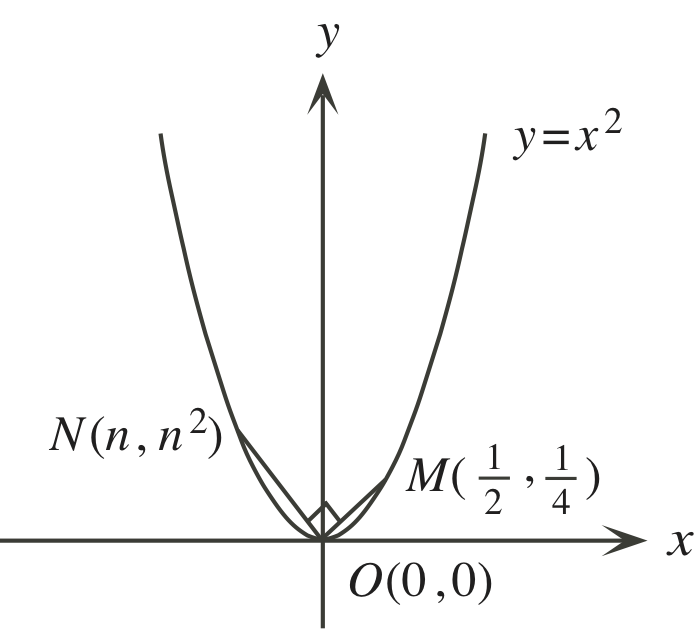
Points M(12,14)M(\frac{1}{2},\frac{1}{4}) and N(n,n2)N(n,n^2) lie on the parabola with equation y=x2y=x^2, as shown.

Figure 0

Determine the value of nn such that ∠MON= 90∘\angle MON=~90^{\circ}.

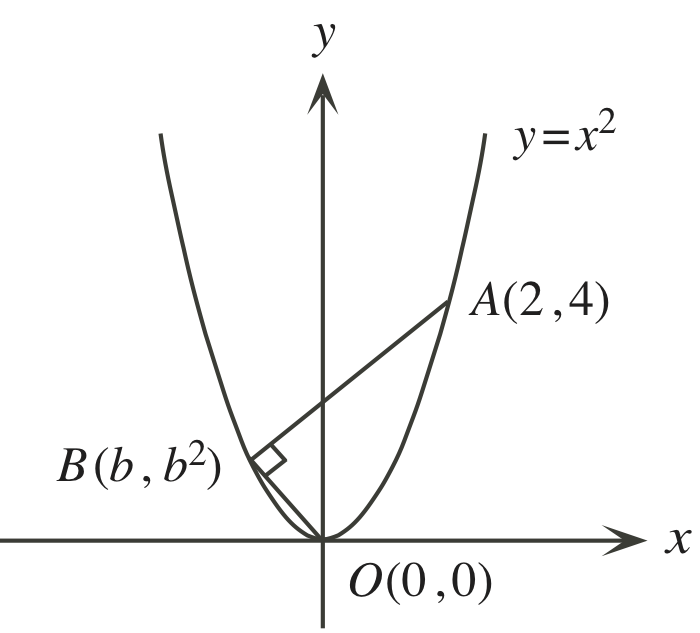
Points A(2,4)A(2,4) and B(b,b2)B(b,b^2) are the endpoints of a chord of the parabola with equation y=x2y=x^2, as shown.

Figure 1

Determine the value of bb so that ∠ABO= 90∘\angle ABO=~90^{\circ}.

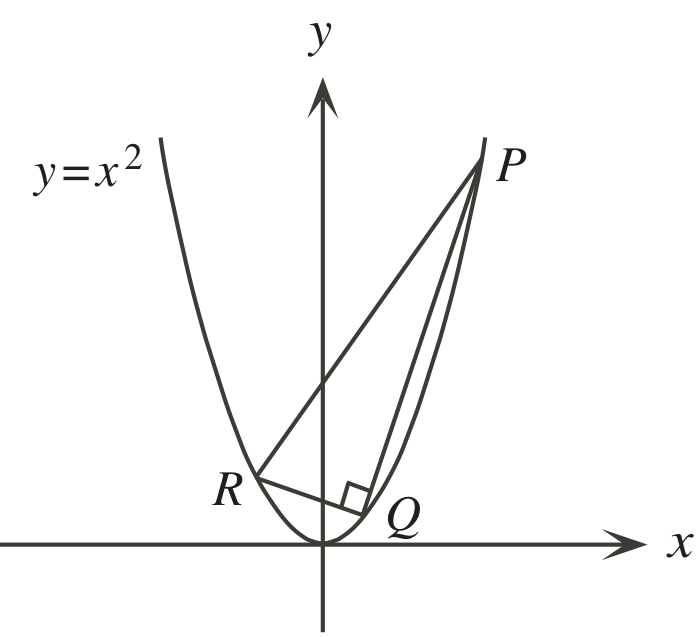
Right-angled triangle PQRPQR is inscribed in the parabola with equation y=x2y=x^2, as shown.

Figure 2

Points P,QP,Q and RR have coordinates (p,p2),(q,q2)(p,p^2), (q,q^2) and (r,r2)(r,r^2), respectively. If pp, qq and rr are integers, show that 2q+p+r=02q+p+r=0.

Solution

Since ∠MON=90∘\angle MON=90^{\circ}, the product of the slopes of NONO and OMOM is −1-1.

The slope of NONO is n2−0n−0=n\dfrac{n^2-0}{n-0}=n, since n≠0n\neq0 (points NN and OO are distinct).

The slope of OMOM is 14−012−0=12\dfrac{\tfrac{1}{4}-0}{\tfrac{1}{2}-0}=\dfrac{1}{2}.

Thus, n×12=−1n\times\dfrac{1}{2}=-1 or n=−2n=-2.
Since ∠ABO=90∘\angle ABO=90^{\circ}, the product of the slopes of BABA and BOBO is −1-1.

The slope of BABA is b2−4b−2=(b−2)(b+2)b−2=b+2\dfrac{b^2-4}{b-2}=\dfrac{(b-2)(b+2)}{b-2}=b+2, since b≠2b\neq2 (AA and BB are distinct).

The slope of BOBO is b2−0b−0=b\dfrac{b^2-0}{b-0}=b, since b≠0b\neq0 (BB and OO are distinct).

Thus, (b+2)×b=−1(b+2)\times b=-1 or b2+2b+1=0b^2+2b+1=0.

Factoring, (b+1)(b+1)=0(b+1)(b+1)=0 and so b=−1b=-1.
Since ∠PQR=90∘\angle PQR=90^{\circ}, the product of the slopes of PQPQ and RQRQ is −1-1.

The slope of PQPQ is p2−q2p−q=(p−q)(p+q)p−q=p+q\dfrac{p^2-q^2}{p-q}=\dfrac{(p-q)(p+q)}{p-q}=p+q, since p≠qp\neq q (PP and QQ are distinct).

The slope of RQRQ is r2−q2r−q=(r−q)(r+q)r−q=r+q\dfrac{r^2-q^2}{r-q}=\dfrac{(r-q)(r+q)}{r-q}=r+q, since r≠qr\neq q (RR and QQ are distinct).

Thus, (p+q)×(r+q)=−1(p+q)\times (r+q)=-1.

Since p,qp,q and rr are integers, then p+qp+q and r+qr+q are integers.

In order that (p+q)×(r+q)=−1(p+q)\times (r+q)=-1, either p+q=1p+q=1 and r+q=−1r+q=-1 or p+q=−1p+q=-1 and r+q=1r+q=1 (these are the only possibilities for integers p,q,rp,q,r for which (p+q)×(r+q)=−1(p+q)\times (r+q)=-1).

In the first case, we add the two equations to get p+q+r+q=1+(−1)p+q+r+q=1+(-1) or 2q+p+r=02q+p+r=0.

In the second case, adding the two equations gives p+q+r+q=−1+1p+q+r+q=-1+1 or 2q+p+r=02q+p+r=0.

In either case, 2q+p+r=02q+p+r=0, as required.

Want a route through all this instead of an archive? The track puts 2,604 problems in a working order, from Junior Challenge level to the IMO shortlist.

Source: CEMC, University of Waterloo, licensed CC-BY-NC-4.0. Statement reproduced verbatim; metadata (topic, difficulty) added by this project.