Solution 1
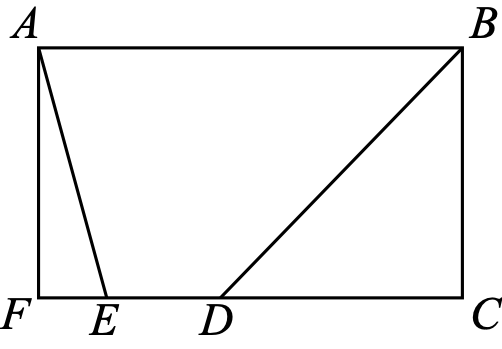
Since AB and ED are parallel, quadrilateral ABDE is a trapezoid.
We know that AB=30 cm.
Since ABCF is a rectangle, then
FC=AB=30 cm.
Suppose that DC=x cm.
Then ED=FC−FE−DC=(30 cm)−(5 cm)−(x cm)=(25−x) cm.
The height of the trapezoid is the length of AF, which is 14 cm.
Since the area of the trapezoid is 266 cm2, then 266 cm226653238xamp;=230 cm+(25−x) cm×(14 cm)amp;=255−x×14amp;=(55−x)×14amp;=55−xamp;=55−38 and so DE=x cm=17 cm.
Solution 2
Let DC=x cm.
Rectangle ABCF has AB=30 cm and AF=14 cm, and so the area of
ABCF is (30 cm)×(14 cm)=420 cm2.
The area of △AFE, which is
right-angled at F, is 21×AF×FE=21×(14 cm)×(5 cm)=35 cm2 The
area of quadrilateral ABDE is 266 cm2.
The area of △BCD, which is
right-angled at C, is 21×BC×DC=21×(14 cm)×(x cm)=7x cm2
Comparing the area of rectangle ABCF to the combined areas of the pieces,
we obtain (35 cm2)+(266 cm2)+(7x cm2)301+7x7xxamp;=420 cm2amp;=420amp;=119amp;=17 Thus, the length of DC is 17 cm.