Maths Olympiad Prep

Library / /374 of 387

, 2020

Geometry Difficulty 3.8 AMC 10/12 Find the answer Canada

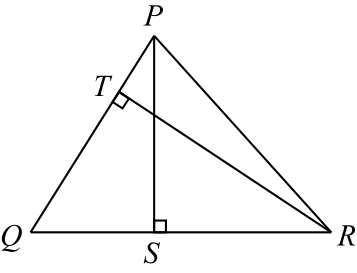
In the diagram, points SS and TT are on sides QRQR and PQPQ, respectively, of PQR\triangle PQR so that PSPS is perpendicular to QRQR and RTRT is perpendicular to PQPQ.Figure 0If PT=1PT=1, TQ=4TQ=4, and QS=3QS=3, what is the length of SRSR? 33 113\frac{11}{3} 154\frac{15}{4} 72\frac{7}{2} 44

A number or a short expression. Fractions can be typed as 3/2, and spacing doesn't matter.

Solution

Since PT=1PT=1 and TQ=4TQ=4, then PQ=PT+TQ=1+4=5PQ = PT+TQ=1+4=5. PSQ\triangle PSQ is right-angled at SS and has hypotenuse PQPQ. We can thus apply the Pythagorean Theorem to obtain PS2=PQ2QS2=5232=16PS^2 = PQ^2 - QS^2 = 5^2 - 3^2 = 16. Since PS>0PS>0, then PS=4PS=4. Consider PSQ\triangle PSQ and RTQ\triangle RTQ. Each is right-angled and they share a common angle at QQ. Thus, these two triangles are similar. This tells us that PQQS=QRTQ\dfrac{PQ}{QS} = \dfrac{QR}{TQ}. Using the lengths that we know, 53=QR4\dfrac{5}{3} = \dfrac{QR}{4} and so QR=453=203QR = \dfrac{4 \cdot 5}{3} = \dfrac{20}{3}. Finally, SR=QRQS=2033=113SR = QR - QS = \dfrac{20}{3} - 3 = \dfrac{11}{3}.

Figure for this problem

Want a route through all this instead of an archive? The track puts 2,604 problems in a working order, from Junior Challenge level to the IMO shortlist.

Source: CEMC, University of Waterloo, licensed CC-BY-NC-4.0. Statement reproduced verbatim; metadata (topic, difficulty) added by this project.