In the diagram, is a quarter of a circle with radius 8. A semi-circle with diameter is drawn, as shown. A second semi-circle with diameter is also drawn.
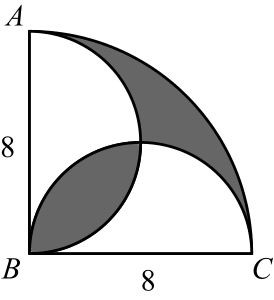
The area of the shaded region is closest to
In the diagram, is a quarter of a circle with radius 8. A semi-circle with diameter is drawn, as shown. A second semi-circle with diameter is also drawn.
The area of the shaded region is closest to
Pick one
We begin by constructing rectangle around the given quadrilateral , as shown.
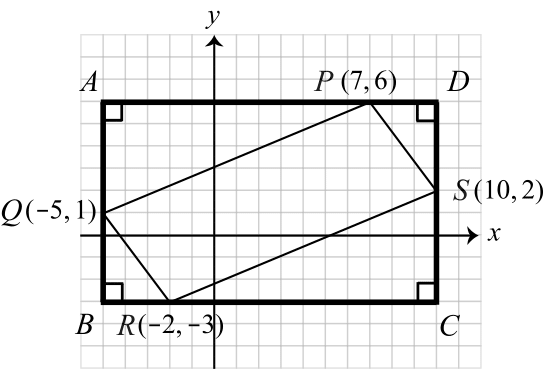
The vertical sides and pass through points and , respectively.
The horizontal sides and pass through points and , respectively.
We determine the area of by subtracting the areas of the four right-angled triangles, , , , and , from the area of .
To determine the horizontal side lengths of the right-angled triangles we count units along the -axis, or we subtract the -coordinates of two vertices.
For example, since is vertical and passes through , the -coordinates of and are equal to that of , which is .
Thus, the length of is determined by subtracting the -coordinate of from the -coordinate of , which is 7.
Therefore the length of is .
Similarly, the length of is .
Since is vertical and passes through , the -coordinates of and are equal to that of , which is .
Thus, the length of is , and the length of is .
To determine the vertical side lengths of the right-angled triangles we may count units along the -axis, or we may subtract the -coordinates of two vertices.
For example, since is horizontal and passes through , the -coordinates of and are equal to that of , which is .
Thus, the length of is determined by subtracting the -coordinate of (which is 1) from the -coordinate of .
Therefore the length of is .
Similarly, the length of is .
Since is horizontal and passes through , the -coordinates of and are equal to that of , which is .
Thus, the length of is , and the length of is .
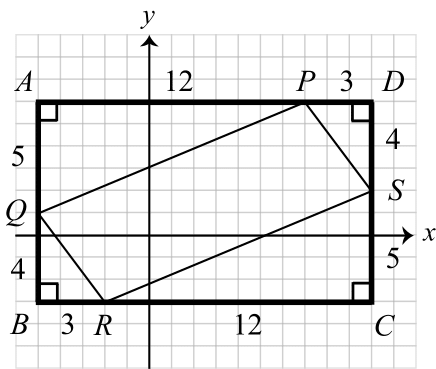
The area of is .
The area of is also 30.
The area of is .
The area of is also 6.
Since and , the area of is .
Finally, the area of is .