Stones are numbered . Three groups of stones can be selected so that the sum of each group is 11. For example, one arrangement is , , . Including the example, how many arrangements are possible?
CEMC Gauss (Grade 8), 2012
Pick one
Solution
Diagonal divides parallelogram into two equal areas.
That is, the area of is one half of the area of parallelogram , or 20.
In , we construct median .
(A median is a line segment that joins a vertex of a triangle to the midpoint of its opposite side.)
Median divides into two equal areas since its base, , is halved while the height remains the same.
That is, the area of is one half of the area of , or 10.
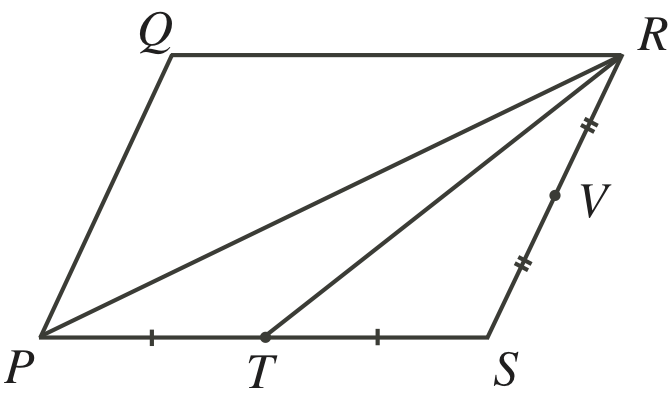
Similarly, we construct median in , as shown.
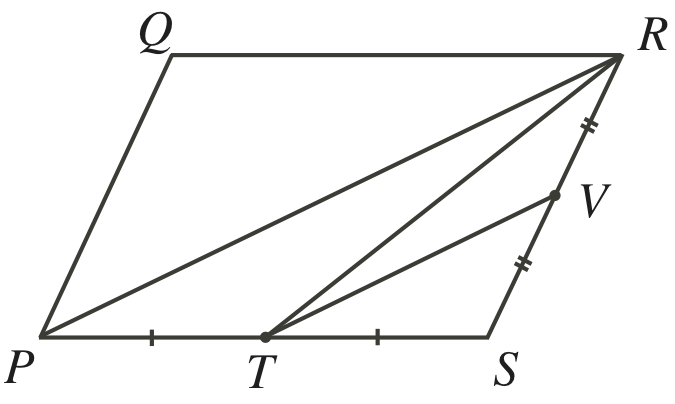
Median divides into two equal areas since its base, , is halved while the height remains the same.
That is, the area of is one half of the area of , or 5.
The area of is equal to the area of subtracted from the area of , or .
Want a route through all this instead of an archive? The track
puts 2,604 problems in a working order, from Junior Challenge level to the IMO shortlist.