The points , and form a triangle whose area is less than or equal to 10. Let be the region formed by all such points with and . When written as a fraction in lowest terms, the area of is equal to for some positive integers and . The value of is
CEMC Cayley, 2021
Pick one
Solution
The distance between and is equal to .
Therefore, if we consider as having base and height , then we want which means that .
In other words, can be any point with and whose perpendicular distance to the line through and is at most 4.
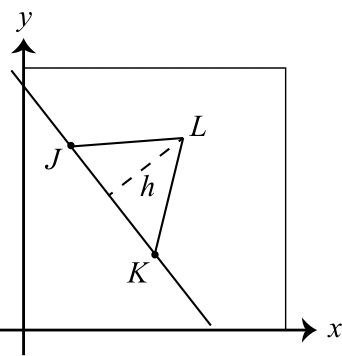
The slope of the line through and is equal to .
Therefore, this line has equation .
Muliplying through by 3, we obtain or .
We determine the equation of the line above this line that is parallel to it and a perpendicular distance of 4 from it.
The equation of this line will be of the form for some real number , since it is parallel to the line with equation .
To determine the value of , we determine the coordinates of one point on this line.
To determine such a point, we draw a perpendicular of length 4 from to a point above the line.
Since has slope and is perpendicular to , then has slope .
Draw a vertical line from and a horizontal line from , meeting at .
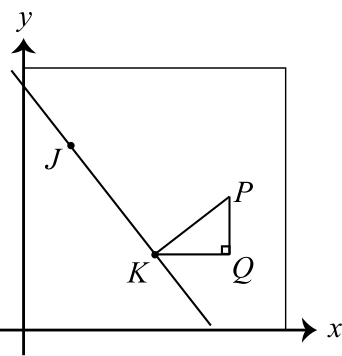
Since has slope , then , which means that is similar to a 3-4-5 triangle.
Since , then and .
Thus, the coordinates of are or .
Since lies on the line with equation , then and so the equation of the line parallel to and 4 units above it is .
In a similar way, we find that the line parallel to and 4 units below it has equation . (Note that .)
This gives us the following diagram:
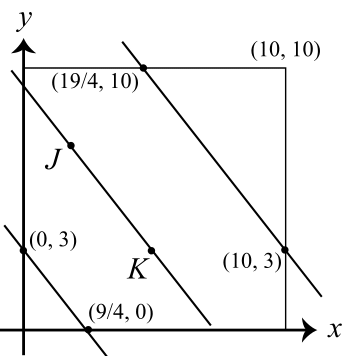
The points that satisfy the given conditions are exactly the points within the square, below the line and above the line . In other words, the region is the region inside the square and between these lines.
To find the area of , we take the area of the square bounded by the lines , , , and (this area equals or 100) and subtract the area of the two triangles inside the square and not between the lines.
The line with equation intersects the -axis at (we see this by setting ) and the -axis at (we see this by setting ).
The line with equation intersects the line at (we see this by setting ) and the line at (we see this by setting ).
The bottom triangle that is inside the square and outside has area .
The top triangle that is inside the square and outside has horizontal base of length or and vertical height of length or , and thus has area .
Finally, this means that the area of is which is in lowest terms since the only divisors of the denominator that are larger than 1 are 2 and 4, while the numerator is odd.
When we write this area in the form where and are positive integers, we obtain and , giving .
Want a route through all this instead of an archive? The track
puts 2,604 problems in a working order, from Junior Challenge level to the IMO shortlist.