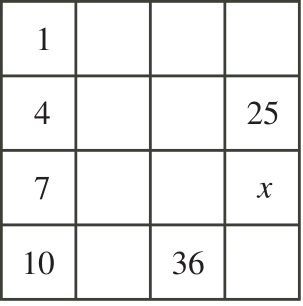
We use labels, m and n, in the fourth row of the grid, as shown.
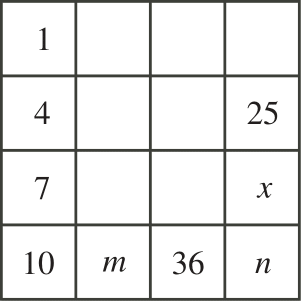
Then, 10,m,36,n are four terms of an arithmetic sequence.
Since 10 and 36 are two terms apart in this sequence, and their difference is 36−10=26, the constant added to one term to obtain the next term in the fourth row is 226 or 13.
That is, m=10+13=23, and n=36+13=49.
(We confirm that the terms 10,23,36,49 do form an arithmetic sequence.)
In the fourth column, 25 and n (which equals 49) are two terms apart in this sequence, and their difference is 49−25=24. Thus, the constant added to one term to obtain the next term in the fourth column is 224 or 12.
That is, x=25+12=37 (or x=49−12=37).
The completed grid is as shown.