There is one positive integer for which . What is this positive integer ?
What is the sum of the smallest odd positive
integers?
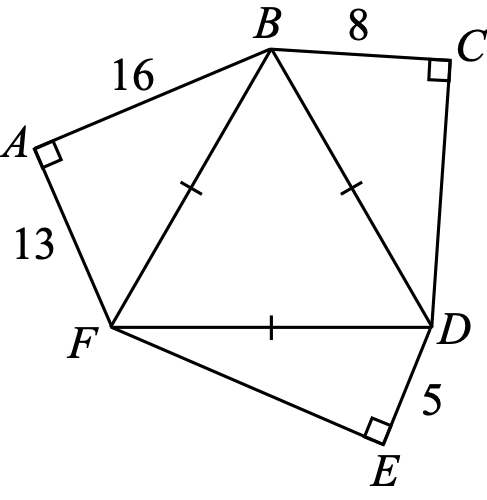
In the diagram, is equilateral and . Also, ,
, , and . Determine the perimeter of
hexagon .
There is one positive integer for which . What is this positive integer ?
What is the sum of the smallest odd positive
integers?
In the diagram, is equilateral and . Also, ,
, , and . Determine the perimeter of
hexagon .
Since , then . (We can square each part and preserve the direction of the
inequalities since each part is positive.)
Therefore,
and so .
Since is a positive integer whose
square is between 5 and 12, then .
Let be the sum of the 20
smallest odd positive integers.
Then .
(Note that the smallest odd positive integer is 1 and the 20th integer
in this list must be greater than the 1st integer.)
If we rewrite the terms of in
reverse order, we obtain .
Adding these two representations, we obtain There are 20 terms in this sum because there were 20 terms
in each of the sums. Each term in this sum equals 40 because the first
pair adds to 40 and each subsequent pair has one number increased by 2
and one number decreased by 2, which means that the sum does not
change.
Therefore,
and so the sum of the 20 smallest odd integers is .
Since is
right-angled at , then by the
Pythagorean Theorem, Since is equilateral, then and so .
Since is right-angled
at , then .
Since , then which gives .
Since , then .
Since is right-angled
at , then .
Since , then which gives .
Since , then .
Therefore, the perimeter of
is ,
which equals or .