Given an acute-angled triangle . The points and lie on the rays opposite to and , respectively, such that and . Prove that the circumcenter of lies on the circumcircle of . (Patrik Bak)
Czech and Slovak Mathematical Olympiad
Solutions — 3
Solution 1
Since the line segments , have the same length , is an isosceles triangle with base . It means that the perpendicular bisector of coincides with the bisector of the angle . Let be the intersection of this bisector with the circumcircle of . If we prove that is a circumcenter of we will be finished. Since lies on the perpendicular bisector of , we have . So, it remains to prove that .
From congruence of inscribed angles and it follows that is the midpoint of the arc , and therefore . From the cyclic quadrilateral we have . Together with equality we get that triangles and are congruent by condition and therefore .
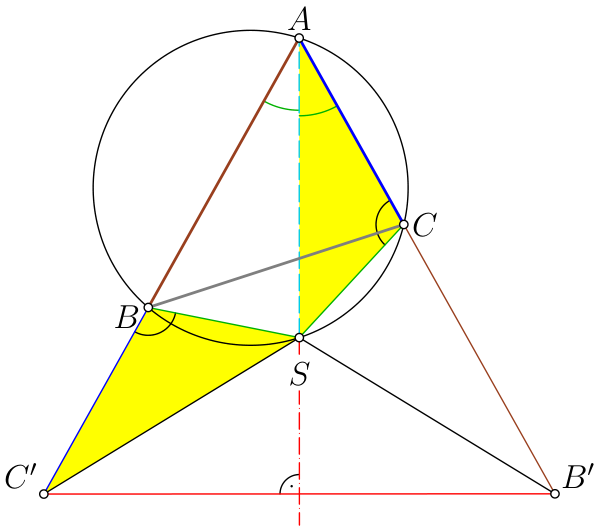
Figure 1
Solution 2
Let us define the point as in the first solution. This time we verify the desired equality by showing that lies on the perpendicular bisector of .
In the special case where holds, the midpoint of is (according to the construction of ); therefore it suffices to verify that the angle is right. However, this follows from the fact that the cyclic quadrilateral is then composed of two identical triangles and , so the angles at their opposite vertices and are identical and therefore right.
When , we can without loss of generality assume that as in figure 2. Here and denote the perpendicular projections of onto lines and , respectively. Thanks to our assumption the point lies inside the segment , while the point lies on the opposite ray to the ray . We prove that is the midpoint of .
BPS and CQS, also the angles PSB and QSC have the same size. In addition, we have , since lies on the angle bisector of . We thus obtain that triangles and are congruent according to condition ASA. Hence, equality follows. Moreover, from the identical rectangular triangles and we also have , so together it yields
Thus, is indeed the midpoint of , and the proof is complete.
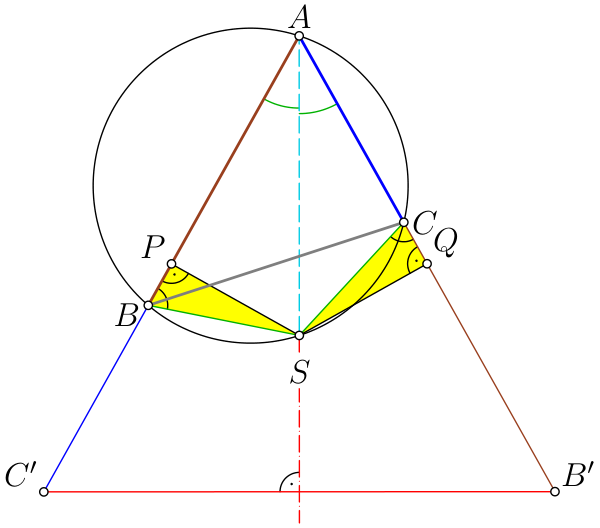
Figure 2
Solution 3
This time we denote by the circumcenter of and we prove that points , , , and lie on one circle. According to the introduction of the first solution, we know that is an isosceles triangle with base , hence its circumcenter lies on the angle bisector of , that is . The points and therefore lie in the opposite half-planes with the boundary line , therefore it is sufficient to verify .
By equalities and , the triangles and are isosceles and congruent. Thus, if we rotate triangle around about the oriented angle we obtain triangle . Since lies on , lies on and at the same time , this rotation maps onto and thus the angle to the angle . Therefore, , which already follows as we promised to show.
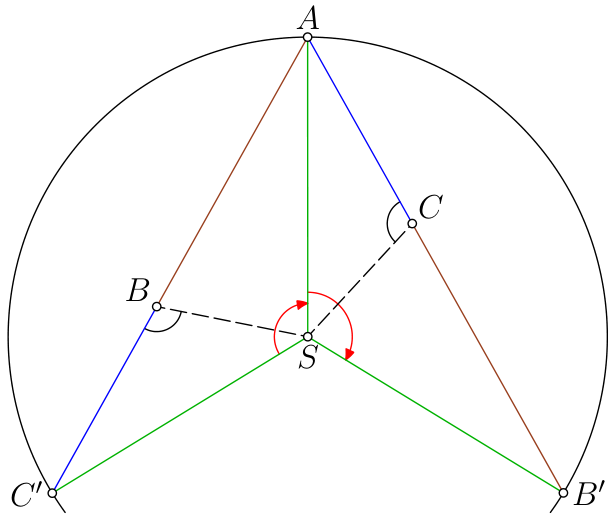
Figure 3
Want a route through all this instead of an archive? The track
puts 2,604 problems in a working order, from Junior Challenge level to the IMO shortlist.