Let k be a semicircle with diameter PQ. Consider a chord BC of fixed length d whose endpoints are distinct from P, Q. A ray of light emanating from B reaches point C after reflecting from PQ at such a point A that ∠PAB=∠QAC. Prove that ∠BAC doesn't depend on the position of the chord BC on k.
(Šárka Gergelitsová)
Solutions — 2
Solution 1
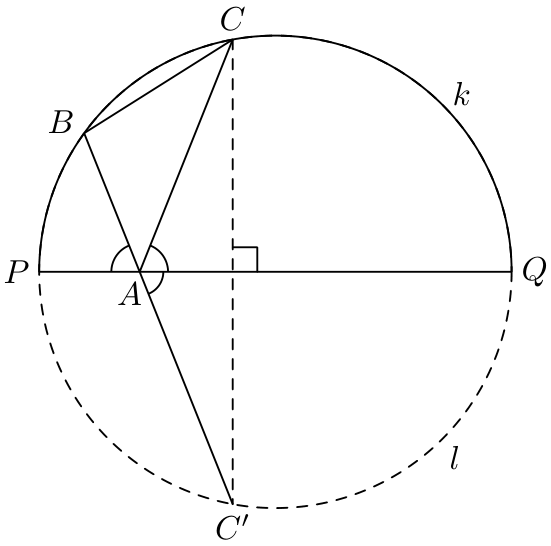
Reflect k and C about PQ to get l and C′, respectively (Fig. 1). Then C′ lies on l and since ∠QAC′=∠QAC=∠PAB it also lies on BA. Triangle C′CA is isosceles, hence ∠BAC=∠AC′C+∠ACC′=2⋅∠BC′C The chord BC of circle k∪l has a fixed length, hence the corresponding inscribed angle BC′C has fixed size and we may conclude.
Fig. 1
Solution 2
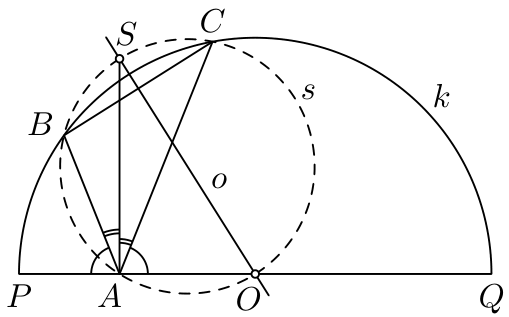
Let O be the midpoint of PQ. We will show that O lies on the circumcircle of triangle ABC (Fig. 2). This will imply that ∠BAC=∠BOC which is clearly fixed. Observe that O lies on the perpendicular bisector of BC. Moreover, if O=A then AO is the external A-angle bisector with respect to triangle ABC. Therefore O is the midpoint of arc BAC.
Fig. 2
Want a route through all this instead of an archive? The track
puts 2,604 problems in a working order, from Junior Challenge level to the IMO shortlist.
Source: MathNet,
licensed CC-BY-4.0.
Statement reproduced verbatim; metadata (topic, difficulty) added by this project.