Let be a point different from the vertices on the side of a triangle . Let and be the incenters of the triangles , and , respectively. Let be the second intersection point of the circumcircles of the triangles and , and be the second intersection point of the circumcircles of the triangles and . Prove that if , then
Team Selection Test for IMO, 2011
Solution
Let be the point of intersection of the bisectors of the angles and . Since and , we have . Therefore are concyclic. We also have , and hence are concyclic too. We conclude that . Similarly, is the point of intersection of the bisectors of and .
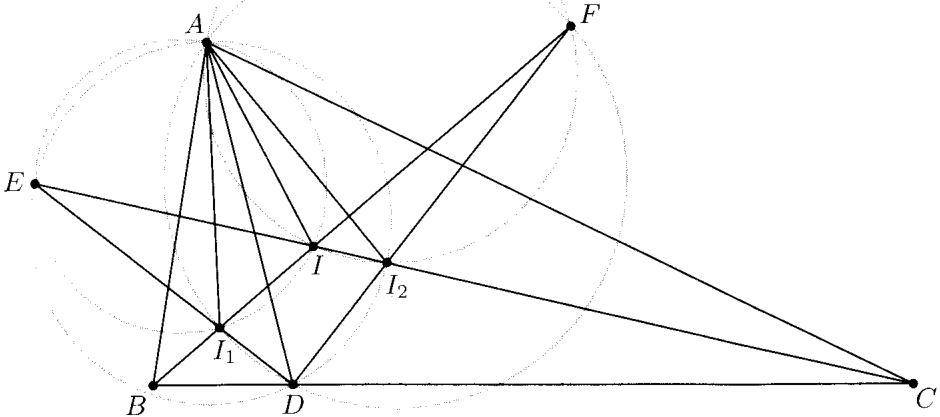
Since and , the triangles and are similar. Hence . Similarly, . As these give .
By Menelaus Theorem for the line and the triangle , and for the line and the triangle we have
respectively. From these we obtain
Want a route through all this instead of an archive? The track
puts 2,604 problems in a working order, from Junior Challenge level to the IMO shortlist.