Let be the circumcircle of a scalene triangle with . The points and are chosen on the internal angle bisectors of the angles and , respectively, so that and . The line meets at points and . Prove that the triangle is isosceles.
Russian Mathematical Olympiad
Solution
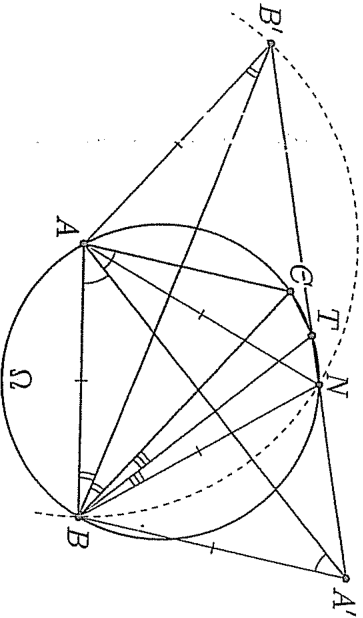
Let be the midpoint of the arc , and be the midpoint of the lesser arc . Prove that and lie on . For this purpose, notice that .
From the parallelism of the lines and , we get that . Therefore, . Similarly, . Denote , . Let, without loss of generality, .
Let be the midpoint of the arc of the circle (see Fig. 12). Then and ; therefore, . Therefore, point is the center of the circle described around , whence and
and ; therefore, . Therefore, point is the center of the circle described around , whence and
. Similarly, , whence . Thus, point lies on the line .
Let be the midpoint of the lesser arc of the circle . Note that . Therefore, point also lies on the line , and triangle coincides with triangle . This triangle is isosceles, since .
Want a route through all this instead of an archive? The track
puts 2,604 problems in a working order, from Junior Challenge level to the IMO shortlist.