Maths Olympiad Prep

Library / /5 of 27

, 2012

Geometry Difficulty 5.1 AIME, harder Prove it India

Let ABCABC be an isosceles triangle with AB=ACAB = AC. Let DD be a point on the segment BCBC such that BD=2DCBD = 2DC. Let PP be a point on the segment ADAD such that BAC=BPD\angle BAC = \angle BPD. Prove that BAC=2DPC\angle BAC = 2\angle DPC.

Solution

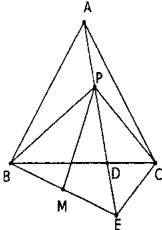
Extend ADAD to EE such that PE=PBPE = PB. Join EBEB and ECEC.

Figure 1

BPE=BAC and PBPE=ABAC=1. \angle BPE = \angle BAC \text{ and } \frac{PB}{PE} = \frac{AB}{AC} = 1.

Hence it follows that CABCAB is similar to EFBEFB. Thus PEB\angle PEB. This shows that AA, BB, EE, CC are concyclic. In turn we obtain
AEC=ABC=ACB=AEB. \angle AEC = \angle ABC = \angle ACB = \angle AEB.

We conclude that AEAE bisects BEC\angle BEC.

Let MM be the mid-point of BEBE. Join PMPM and PCPC. Since EAEA bisects BEC\angle BEC, we have
CEEB=CDDB=CD2CD=12. \frac{CE}{EB} = \frac{CD}{DB} = \frac{CD}{2CD} = \frac{1}{2}.

Thus CE=EB/2=EMCE = EB/2 = EM. We also observe that MEP=CEP\angle MEP = \angle CEP. This shows that CEPCEP is congruent to MEPMEP. This implies that
BAC=BPE=2MPE=2DPC. \angle BAC = \angle BPE = 2\angle MPE = 2\angle DPC.

Want a route through all this instead of an archive? The track puts 2,000 problems in a working order, from AMC 10 level to the IMO shortlist.

Source: MathNet, licensed CC-BY-4.0. Statement and solution reproduced as published; topic and difficulty added by this site.