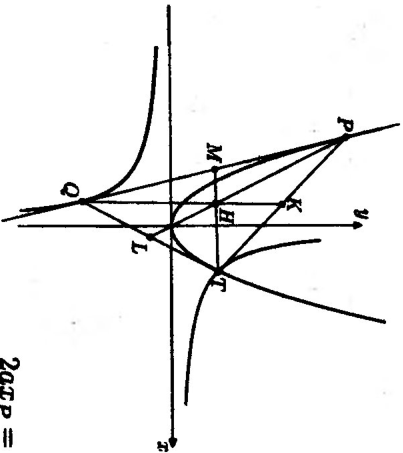
A parabola y=ax2, a>0, and the hyperbola y=1/x meet at point T. The common tangent of these curves touches the hyperbola at point Q and touches the parabola at point P. a) Prove that some two medians of the triangle PQT are perpendicular. b) Determine the area of the triangle PQT. (V. Karamzin)
Solution
b) Answer: S=27/4. We find the coordinates (xT;yT) of the point of intersection of the parabola y=ax2 and the hyperbola y=1/x. We have axT2=1/xT, so xT=1/a=1/t and yT=1/xT=t. The equation of the tangent to the parabola at point P(xP;yP) has the form y−yP=2axP(x−xP), and the equation of the tangent to the hyperbola at point Q(xQ;yQ) has the form y−yQ=(−1/xQ2)(x−xQ). Since the tangent is a common tangent for both the graphs, we have 2axP=−1/xQ2,(1) −2axP2+yP=1/xQ+yQ.(2) Since yP=axP2 and yQ=1/xQ, the obtained equality has the form −axP2=2/xQ.(2) From equations (1), (2) it follows that xQ=−1/(2t), xP=−2/t, and so yQ=−2t, yP=4t. Therefore, T(t1;t),P(−t2;4t),Q(−2t1;−2t).(3) Let M,K,L be the midpoints of the sides PQ,PT,TQ respectively. Then M(−4t5;t),K(−2t1;25t);L(4t1;−2t). Comparing the obtained values with (3), we note that MT parallel to the axis Ox, since yM=yT, and QK parallel to Oy, since yQ=yK. Therefore, medians MT and QK in the triangle PQT are perpendicular, as required. Let H be a centroid of the triangle PQT. Then S(PQT)=2S(QKT)=[TH⊥QK]=2⋅21QK⋅TH==[TH=32MT]=32QK⋅TM. Since TM∥Ox, we have TM=1/t−(−5/(4t))=9/(4t), Similarly, since QK∥Oy, we have QK=5t/2−(−2t)=9t/2. Therefore, S(PQT)=32⋅4t9⋅29t=427.
Want a route through all this instead of an archive? The track
puts 2,604 problems in a working order, from Junior Challenge level to the IMO shortlist.
Source: MathNet,
licensed CC-BY-4.0.
Statement reproduced verbatim; metadata (topic, difficulty) added by this project.