Answer: ∠A=54∘, ∠B=126∘, ∠C=72∘, ∠D=108∘.
Let CD=AO=a, BC=OD=b and ∠BCD=2α. By condition,
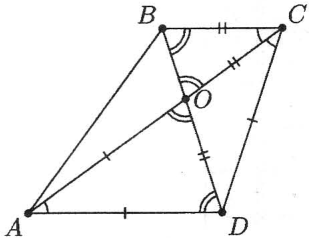
BD=y, ∠DCA=∠ACB=α. Since BC∥AD, we have ∠CAD=∠ACB=α. So △ADC is an isosceles triangle and AD=CD=a. Then △AOD is also an isosceles triangle (AO=a and AD=a). Therefore, ∠AOD=∠ADO.
Further, since ∠BOC=∠AOD (vertical angles) and ∠OBC=∠ODA (alternate angles for BC∥AD), we see that △BOC is an isosceles triangle, so OC=BC=b. Thus, △COD is also an isosceles triangle (OC=b and OD=b). Therefore, ∠ODC=∠OCD=α.
Then in △COD the external angle ∠BOC=∠OCD+∠ODC=α+α=2α, hence, ∠OBC=∠BOC=2α. It means that △BCD is an isosceles triangle (∠DBC=2α and ∠BC=2α). Then BD=CD=a=AD and so △ADB is also an isosceles triangle.
In △BCD the sum ∠BCD+∠CDB+∠DBC=2α+α+2α=5α. Since the sum of all angles of a triangle is equal to 180∘, we have 5α=180∘, hence α=36∘.
Then for the trapezoid ABCD we have ∠C=2α=72∘, ∠D=180∘−∠C=180∘−72∘=108∘. Since △ADB is isosceles, we have ∠A=21(180∘−∠ADB)=21(180∘−2α)=90∘−α=90∘−36∘=54∘. Hence, ∠B=180∘−∠A=180∘−54∘=126∘.