Maths Olympiad Prep

Library / /99 of 100

Algebra Difficulty 7.2 National olympiad, round 2 Prove it China

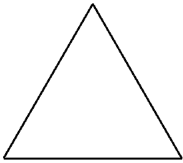
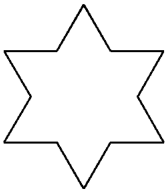
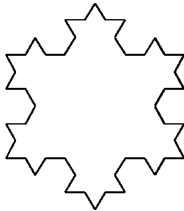
As shown in the diagram, there is a sequence of the curves P0,P1,P2,P_0, P_1, P_2, \dots. It is known that the region enclosed by P0P_0 has area 11 and P0P_0 is an equilateral triangle. We obtain Pk+1P_{k+1} from PkP_k by operating as follows: Trisecting every side of PkP_k, then we construct an equilateral triangle outwardly on every side of PkP_k sitting on the middle segment of the side and finally remove this middle segment (k=0,1,2,k = 0, 1, 2, \dots). Write SnS_n as the area of the region enclosed by PnP_n.

(1) Find a formula for the general term of the sequence of numbers {Sn}\{S_n\};
(2) Find limnSn\lim_{n \to \infty} S_n.

Figure 1
P0P_0
Figure 2
P1P_1
Figure 3
P2P_2
...

Solution

(1) We perform the operation on P0P_0. It is easy to see that each side of P0P_0 becomes 44 sides of P1P_1. So the number of sides of P1P_1 is 343 \cdot 4. In the same way, we operate on P1P_1. Each side of P1P_1 becomes 44 sides of P2P_2. So the number of sides of P2P_2 is 3423 \cdot 4^2. Consequently, it is not difficult to get that the number of sides of PnP_n is 34n3 \cdot 4^n.

It is known that the area of P0P_0 is S0=1S_0 = 1. Comparing P1P_1 with P0P_0, it is easy to see that we add to P1P_1 a smaller equilateral triangle with area 132\frac{1}{3^2} on each side of P0P_0. Since P0P_0 has 33 sides, so
S1=S0+3132=1+13. S_1 = S_0 + 3 \cdot \frac{1}{3^2} = 1 + \frac{1}{3}.
Again, comparing P2P_2 with P1P_1, we see that P2P_2 has an additional smaller equilateral triangle with area 132132\frac{1}{3^2} \cdot \frac{1}{3^2} on each side of P1P_1, and P1P_1 has 343 \cdot 4 sides. So that
S2=S1+34134=1+13+433. S_2 = S_1 + 3 \cdot 4 \cdot \frac{1}{3^4} = 1 + \frac{1}{3} + \frac{4}{3^3}.
Similarly, we have
S3=S2+34136=1+13+433+4235. S_3 = S_2 + 3 \cdot 4 \cdot \frac{1}{3^6} = 1 + \frac{1}{3} + \frac{4}{3^3} + \frac{4^2}{3^5}.
Hence, we have
Sn=1+13+433+4235++4n132n1=1+k=1n4k132k1=1+34k=1n(49)k=1+3449[1(49)n]=1+35[1(49)n]=8535(49)n. \begin{align*} S_n &= 1 + \frac{1}{3} + \frac{4}{3^3} + \frac{4^2}{3^5} + \dots + \frac{4^{n-1}}{3^{2n-1}} \\ &= 1 + \sum_{k=1}^{n} \frac{4^{k-1}}{3^{2k-1}} = 1 + \frac{3}{4} \sum_{k=1}^{n} \left(\frac{4}{9}\right)^k \\ &= 1 + \frac{3}{4} \cdot \frac{4}{9} \cdot \left[1 - \left(\frac{4}{9}\right)^n\right] \\ &= 1 + \frac{3}{5} \left[1 - \left(\frac{4}{9}\right)^n\right] \\ &= \frac{8}{5} - \frac{3}{5} \cdot \left(\frac{4}{9}\right)^n. \tag{*} \end{align*}

We will prove ()(*) by mathematical induction as follows:
When n=1n=1, it is known that ()(*) holds from above.
Suppose, when n=kn=k, we have Sk=8535(49)kS_k = \frac{8}{5} - \frac{3}{5} \cdot \left(\frac{4}{9}\right)^k.
When n=k+1n=k+1, it is easy to see that, after k+1k+1 times of operations, by comparing Pk+1P_{k+1} with PkP_k, we have added to Pk+1P_{k+1} a smaller equilateral triangle with area 132(k+1)\frac{1}{3^{2(k+1)}} on each side of PkP_k and PkP_k has 34k3 \cdot 4^k sides. So we get
Sk+1=Sk+34k132(k+1)=Sk+4k32k+1=8535(49)k+1. \begin{aligned} S_{k+1} &= S_k + 3 \cdot 4^k \cdot \frac{1}{3^{2(k+1)}} \\ &= S_k + \frac{4^k}{3^{2k+1}} = \frac{8}{5} - \frac{3}{5} \cdot \left(\frac{4}{9}\right)^{k+1}. \end{aligned}
By mathematical induction, ()(*) is proved.

(2) From (1), we have Sn=8535(49)nS_n = \frac{8}{5} - \frac{3}{5} \cdot \left(\frac{4}{9}\right)^n.
Therefore,
limnSn=limn[8535(49)n]=85. \lim_{n \to \infty} S_n = \lim_{n \to \infty} \left[ \frac{8}{5} - \frac{3}{5} \cdot \left(\frac{4}{9}\right)^n \right] = \frac{8}{5}.

Want a route through all this instead of an archive? The track puts 2,000 problems in a working order, from AMC 10 level to the IMO shortlist.

Source: MathNet, licensed CC-BY-4.0. Statement and solution reproduced as published; topic and difficulty added by this site.