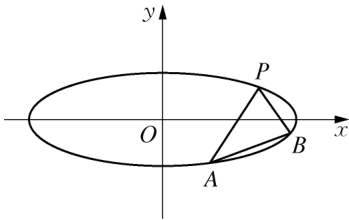
Straight line l with slope 31 intercepts ellipse C:36x2+4y2=1 at points A,B, and point P(32,2) is in the top-left of l (as shown in Fig. 11.1). Fig. 11.1
a. Prove that the center of the inscribed circle of △PAB is on the line x=32.
b. When ∠APB=60∘, find the area of △PAB.
Solution
a. Let l be a straight line such that y=31x+m, and A(x1,y1),B(x2,y2). Substituting y=31x+m into 36x2+4y2=1, and simplifying it, we have 2x2+6mx+9m2−36=0. Then x1+x2=−3m, x1x2=29m2−36, kPA=x1−32y1−2, kPB=x2−32y2−2. Therefore, kPA+kPB=x1−32y1−2+x2−32y2−2=(x1−32)(x2−32)(y1−2)(x2−32)+(y2−2)(x1−32). In the expression above, the numerator is equal to (31x1+m−2)(x2−32)+(31x2+m−2)(x1−32)=32x1x2+(m−22)(x1+x2)−62(m−2)=32⋅29m2−36+(m−22)(−3m)−62(m−2)=3m2−12−3m2+62m−62m+12=0. Therefore, kPA+kPB=0. Since P is in the top-left of l, we know that the bisector of ∠APB is parallel to the y-axis. Therefore, the center of the inscribed circle of △PAB is on line x=32.
b. When ∠APB=60∘, by the result in (a), we have kPA=3, kPB=−3. Then the equation for line PA is y−2=3(x−32). Substituting it into 36x2+4y2=1, and eliminating y, we get 14x2+96(1−33)x+18(13−33)=0, which has roots x1 and 32. So x1⋅32=1418(13−33), i.e. x1=1432(13−33). Then we find ∣PA∣=1+(3)2⋅∣x1−32∣=732(33+1). In the same way, we have ∣PB∣=732(33−1). Therefore, S△PAB=21⋅∣PA∣⋅∣PB∣⋅sin60∘=21⋅732(33+1)⋅732(33−1)⋅23=491173.
Want a route through all this instead of an archive? The track
puts 2,604 problems in a working order, from Junior Challenge level to the IMO shortlist.
Source: MathNet,
licensed CC-BY-4.0.
Statement reproduced verbatim; metadata (topic, difficulty) added by this project.