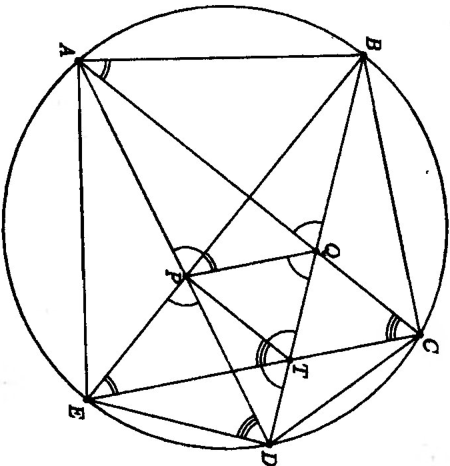
Since AB=BC, CD=DE we have ∼AB=∼BC, ∼CD=∼DE.
Therefore,
∠BPA=∠DPE=21(∼AB+∼DE)=21(∼AB+∼CD)=∠BQA.(1)
So, points A, B, Q, P belong to the same circle and we have
∠QAB=∠QPB (subtended by the same chord BQ)(2)
and
∠QAB=∠CAB=∠CEB (subtended by the same chord BC).(3)
Thus from (2) and (3) we have ∠QPB=∠CEB, so PQ∥CE. Therefore,
∠TQP=∠DTE=21(∼BC+∼DE)=21(∼AB+∼CD)=∠AQB.(4)
Similarly, points P, T, D, E belong to the same circle because
∠EPD=21(∼AB+∼DE)=21(∼BC+∼DE)=∠ETD.
So, ∠PTE=∠PDE (subtended by the same chord PE). Since ∠ACE=∠ADE (subtended by the same chord AE) we have ∠ACE=∠PTE. Therefore, PT∥AC and hence ∠PTQ=∠AQB. Now from (4) it follows that ∠PTQ=∠TQP, thus triangle PTQ is isosceles.