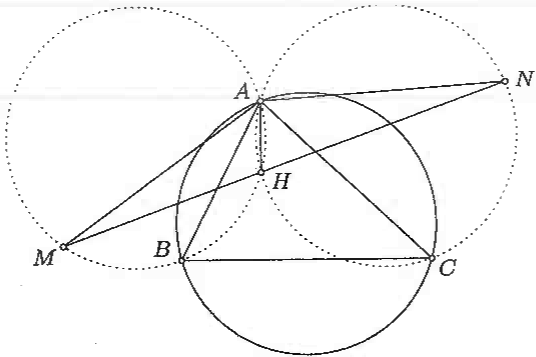
Let ABC be an acute triangle with circumcircle (O). D is a point on arc BC that does not contain A. A moving line l through orthocenter H of triangle ABC cuts the circumcircles of triangle ABH and triangle ACH again at M,N respectively (M=H,N=H).
a) Define the position of l such that the area of AMN has maximal value.
b) Denote d1,d2 be the lines through M and perpendicular to DB, through N perpendicular to DC respectively. Prove that the intersection P of d1 and d2 belongs to a fixed circle.
Solution
a) Firstly, note that when ℓ changes, the angles ∠AMN and ∠ANM both remain unchanged, so triangle AMN is always self-congruent. Draw AK perpendicular to MN (K∈MN), then AK≤AH. Therefore, the area of triangle AMN attains maximal value when AH is the altitude or MN⊥AH. Thus, when Δ⊥AH, the area of triangle AMN is largest.
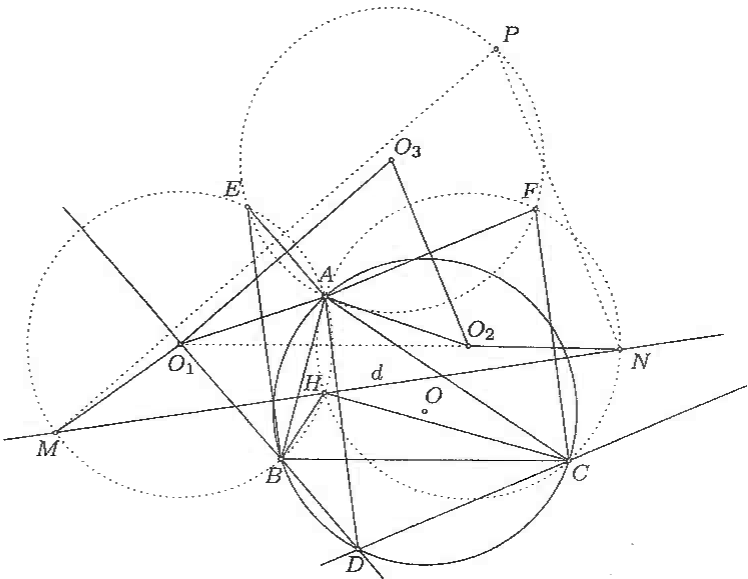
b) Let the line passing through A and parallel to BD intersect (ABM) at E and the line passing through A and parallel to CD intersect (ACH) at F. Notice that the radius of the circles (O), (ABH) and (ACH) are equal, hence ∠ADB=∠AEB, which implies ∠ABD=∠BAE (because BD∥AE). Hence, ∠BAD=∠ABE, it follows that AD∥BE. Thus ADBE is a parallelogram.
Similarly, ADCF is a parallelogram. Therefore, triangle AEF is the image of triangle DBC through the translation Tv with vector v=DA. Denote O1,H1 to be the circumcenter and orthocenter of triangle AEF, respectively. It is well known that OHO1H1=OA+OB+OC=O1A+O1E+O1F, However, O1H1=O1O+OH1, O1A=O1O+OA, and O1E=OB, O1F=OC (image via translation forward Tv). Hence O1O+OH1=O1O+OA+OB+OC, so OH1=OH. Thus, H1≡H.
Now we will prove that the intersection P of d1 and d2 always lies on the circle (AEF). First, since AE∥BD and AF∥CD, we have MP⊥AE and NP⊥AF. Let P1 be the point of symmetry of M through AE, P2 is the symmetry point of N over AF. Since the circles (AEF), (ABH) and (ACH) are equal (because they are equal to the same circle (O)) so P1,P2 are all on the circle (AEF). Note that the Steiner lines of P1 and P2 with respect to the triangle AEF are coincident (that is the line Δ). According to the property of the Steiner line, we deduce that P1≡P2≡P so P always lies on the fixed circle (AEF). □
Want a route through all this instead of an archive? The track
puts 2,604 problems in a working order, from Junior Challenge level to the IMO shortlist.
Source: MathNet,
licensed CC-BY-4.0.
Statement reproduced verbatim; metadata (topic, difficulty) added by this project.