a) Without loss of generality, suppose that AB<AC. Clearly, N lies on the opposite ray of ray BC. Note that AEDF is a cyclic quadrilateral and ∠OAC=90∘−∠ABC, we have
∠AMN=∠MAE+∠MEA=90∘−∠ABC+∠ADF=∠BDF+∠ADF=∠NDA,
which implies AMDN is a cyclic quadrilateral. Thus, (AMN) passes through a fixed point D.
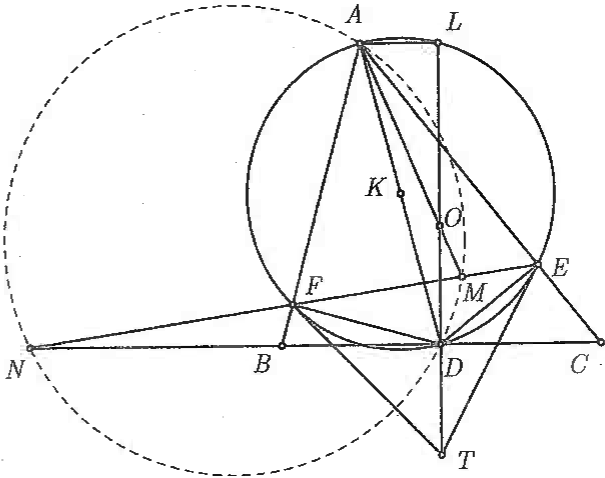
b) Let (K) be the circumcircle of triangle AEF, it is obvious that AD is the diameter of (K). Let L be the point on (K) such that DL⊥BC, we can easily prove AL⊥BC and AL∥BC. Note that D is the midpoint of BC, hence
A(FE,DL)=A(BC,DL)=−1.
This follows that LEDF is a harmonic quadrilateral. Thus, DL passes through T. Clearly, DL is the perpendicular bisector of BC so T lies on a fixed line. □