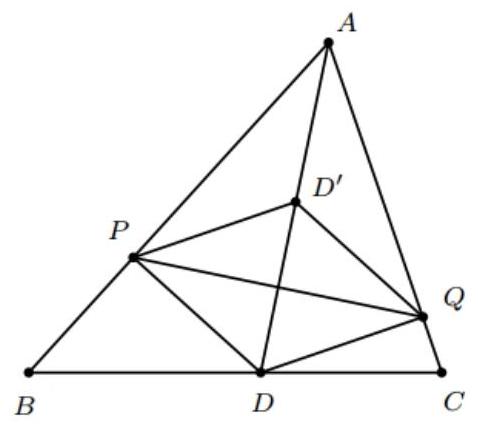
We say that a triangle is great if the following holds: for any point on the side , if and are the feet of the perpendiculars from to the lines and , respectively, then the reflection of in the line lies on the circumcircle of the triangle .
Prove that triangle is great if and only if and .
APMO, 2016
Solution
For every point on the side , let be the reflection of in the line . We will first prove that if the triangle satisfies the condition then it is isosceles and right-angled at .
Choose to be the point where the angle bisector from meets . Note that and lie on the rays and respectively. Furthermore, and are reflections of each other in the line , from which it follows that . Therefore, lies on the line and we may deduce that either or is the second point of the angle bisector at and the circumcircle of . However, since is a cyclic quadrilateral, the segment intersects the segment . Therefore, lies on the ray and therefore . By angle chasing we obtain
and since we also know . This implies that .
Now we choose to be the midpoint of . Since , we can deduce that is the medial triangle of triangle . Therefore, from which it follows that . But the distance from to is equal to both the circumradius of triangle and to the distance from to . This can only happen if . This implies that is isosceles and right-angled at .
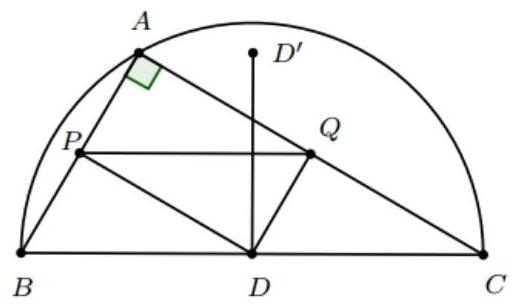
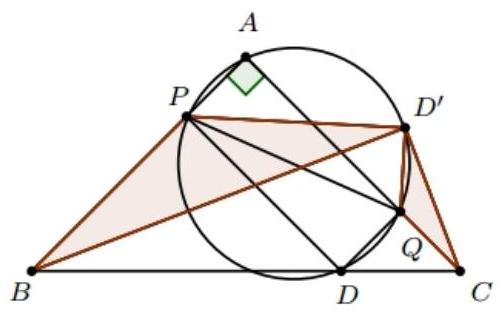
We will now prove that if is isosceles and right-angled at then the required property in the problem holds. Let be any point on side . Then and we also have . Hence, and similarly . Note that is cyclic with diameter . Therefore, , from which we obtain . So triangles and are similar. It follows that and . So we also obtain that triangles and are similar. But since and are congruent, we may deduce that . Therefore, lies on the circle with diameter , which is the circumcircle of triangle .
Want a route through all this instead of an archive? The track
puts 2,604 problems in a working order, from Junior Challenge level to the IMO shortlist.