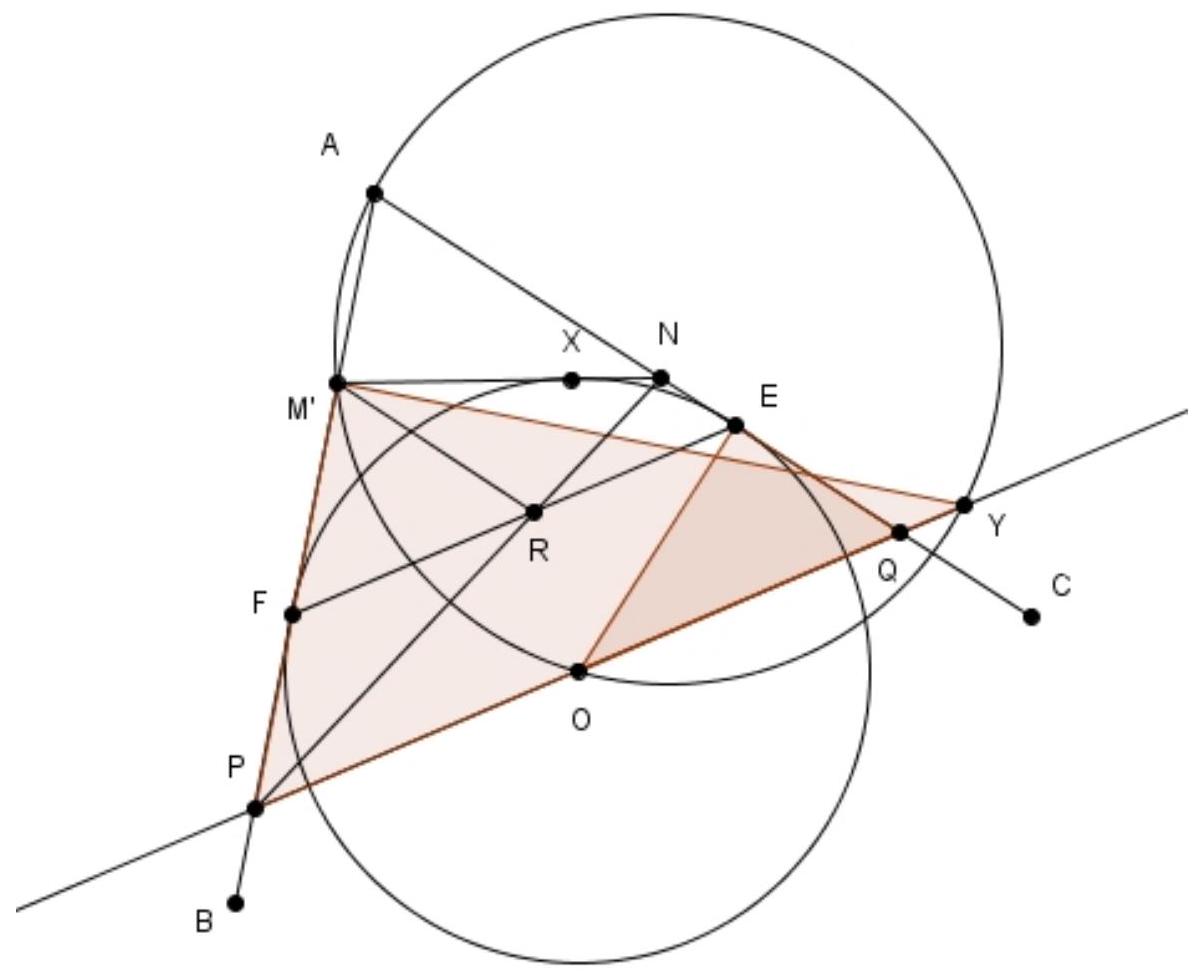
Let the line through N tangent to ω at point X=E intersect AB at point M′. It suffices to show that M′R∥AC, since this would yield M′=M.
Suppose that the line PO intersects AC at Q and the circumcircle of AM′O at Y, respectively. Then
∠AYM′=∠AOM′=90∘−∠M′OP.
By angle chasing we have ∠EOQ=∠FOP=90∘−∠AOF=∠M′AO=∠M′YP and by symmetry ∠EQO=∠M′PY. Therefore △M′YP∼△EOQ.
On the other hand, we have
∠M′OP=∠M′OF+∠FOP=21(∠FOX+∠FOP+∠EOQ)==21(2180∘−∠XOE)=90∘−2∠XOE
Since we know that ∠AYM′ and ∠M′OP are complementary this implies
∠AYM′=2∠XOE=∠NOE
Therefore, ∠AYM′ and ∠NOE are congruent angles, and this means that A and N are corresponding points in the similarity of triangles △M′YP and △EOQ. It follows that
M′PAM′=EQNE=RPNR
We conclude that M′R∥AC, as desired.
As in Solution 1, we introduce point M′, and reduce the problem to proving RNPR=M′APM′. Menelaus theorem in triangle ANP with transversal line FRE yields
RNPR⋅EANE⋅FPAF=1.
Since AF=EA, we have NEFP=RNPR, so that it suffices to prove
NEFP=M′APM′(1)
This is a computation regarding the triangle AM′N and its excircle opposite A. Indeed, setting a=M′N, b=NA, c=M′A, s=2a+b+c, x=s−a, y=s−b and z=s−c, then AE=AF=s, M′F=z and NE=y. From △OFP∼△AFO we have FP=sra2, where ra=OF is the exradius opposite A. Combining the following two standard formulas for the area of a triangle
∣AM′N∣2=xyzs(Heron’s formula) and∣AM′N∣=ra(s−a),
we have ra2=xyzs. Therefore, FP=xyz. We can now write everything in (1) in terms of x,y,z. We conclude that we have to verify
yxyz=x+yz+xyz,
which is easily seen to be true.
As in Solution 1, we introduce point M′. Let the line through M′ and parallel to AN intersect EF at R′. Let P′ be the intersection of lines NR′ and AM. It suffices to show that P′O∥FE, since this would yield P=P′, and then R=R′ and M=M′. Hence it is enough to prove that
FP′AF=DOAD,(2)
where D is the intersection of AO and EF. Once again, this reduces to a computation regarding the triangle AM′N and its excircle opposite A.
Let u=P′F and x,y,z,s as in Solution 2a. Note that since AE=AF and M′R′∥AE, we have M′R′=M′F=z. Since M′R′∥AN, we have P′AP′M′=NAM′R′, that is,
u+x+y+zu+z=x+zz
From this last equation we obtain u=xyz. Hence FP′AF=yzxs. Also, as in Solution 2a, we have ra2=xyzs.
Finally, using similar triangles ODF,FDA and OFA, and the above equalities, we have
DOAD=DFAD⋅DODF=OFAF⋅OFAF=ra2s2=xyzss2=yzxs=FP′AF,
as required.