Maths Olympiad Prep

Library / /18 of 20

Geometry Difficulty 7.5 National olympiad, round 2 Prove it North Macedonia

Let ABC\triangle ABC be an acute triangle with orthocenter HH. The point HH' is symmetric with HH with respect to the line ABAB. Let NN be the intersection point of HHHH' and ABAB. The circle passing through the points AA, NN and HH' intersects again the line ACAC at MM, and the circle passing through the points BB, NN and HH' intersects again the line BCBC at PP. Prove that the points MM, NN and PP are colinear.

Solutions — 2

Solution 1

First, we will show the following lemma.

Lemma. Let HH be an orthocenter in ABC\triangle ABC, and HH' be the symmetric point of HH with respect to ABAB. Then HH' lies on the circle around the triangle ABC\triangle ABC.

Proof.

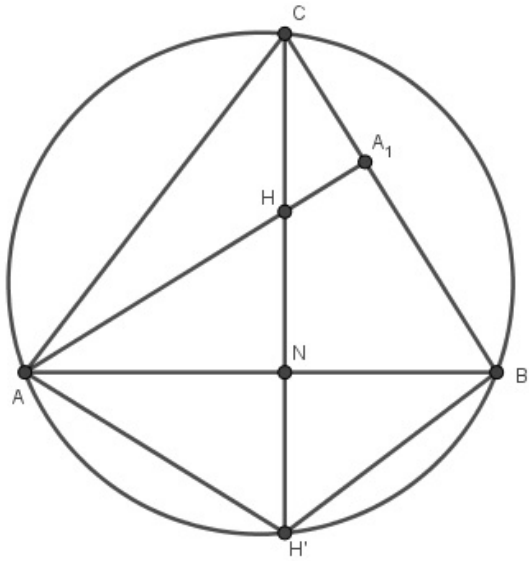
First proof of the lemma. Let NN be the intersection point of HHHH' and ABAB, and A1A_1 be the foot of the height from AA towards BCBC. Then ANHANH\triangle ANH \cong \triangle ANH', since ANAN is a common side, HN=NH\overline{HN} = \overline{NH'} and ANH=ANH=90\angle ANH = \angle ANH' = 90^\circ. From HAB=HAN=NAH=BAA1=90ABC=NCB=HCB\angle H'AB = \angle H'AN = \angle NAH = \angle BAA_1 = 90^\circ - \angle ABC = \angle NCB = \angle H'CB it follows that the quadrilateral AHBCAH'BC is cyclic, i.e. HH' lies on the circle around the triangle ABC\triangle ABC.

Figure 1

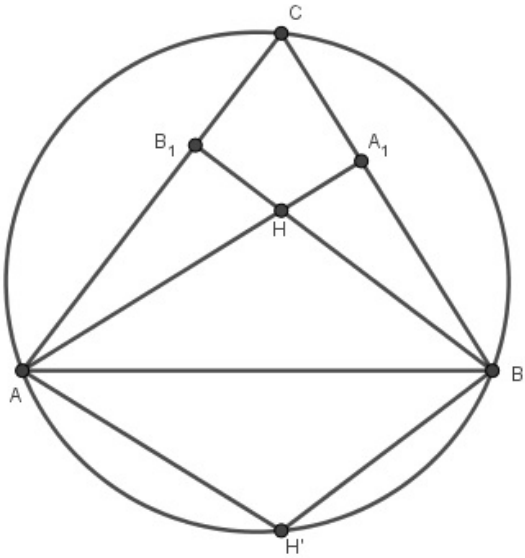
Second proof of the lemma. Let A1A_1 be the foot of the height from AA towards BCBC, and B1B_1 be the foot of the height from BB towards ACAC. From HB1C=HA1C=90\angle HB_1C = \angle HA_1C = 90^\circ it follows that the quadrilateral B1HA1CB_1HA_1C is cyclic. Then A1HB1=180γ=α+β\angle A_1HB_1 = 180^\circ - \gamma = \alpha + \beta, i.e. AHB=A1HB1=α+β\angle AHB = \angle A_1HB_1 = \alpha + \beta. From ANHANH\triangle ANH \cong \triangle ANH' and BNHBNH\triangle BNH \cong \triangle BNH' it follows that AHB=AHB=α+β\angle AH'B = \angle AHB = \alpha + \beta. Then from
AHB+ACB=α+β+γ=180 \angle AH'B + \angle ACB = \alpha + \beta + \gamma = 180^\circ
It follows that the quadrilateral AHBCAH'BC is cyclic, i.e. HH' lies on the circle around the triangle ABC\triangle ABC.

From ANH=90\angle ANH' = 90^\circ it follows that AHAH' is a diameter of the circle around the triangle ANH\triangle ANH'. Then HMA=90\angle H'MA = 90^\circ, i.e.

Figure 2

HMACH'M \perp AC..\quad (1)
Analogously,wecanshowthat Analogously, we can show that
H'P BC.\perp BC.\quad (2)

From the condition of the problem we have

H'N AB.\perp AB.\quad (3)

Using the lemma, we conclude that the quadrilateral AHBCAH'BC is cyclic. From (1), (2), (3) and the theorem of Simpson for ABC\triangle ABC and having in mind that HH' lies on the circle around the triangle ABC\triangle ABC, it follows the statement of the problem.

Solution 2

Using the power of point theorem, we have
CACM=CNCH=CPCB, i.e. CACM=CPCB \overline{CA} \cdot \overline{CM} = \overline{CN} \cdot \overline{CH'} = \overline{CP} \cdot \overline{CB}, \text{ i.e. } \overline{CA} \cdot \overline{CM} = \overline{CP} \cdot \overline{CB}
CMCP=CBCA.(1) \frac{\overline{CM}}{\overline{CP}} = \frac{\overline{CB}}{\overline{CA}}.\quad (1)

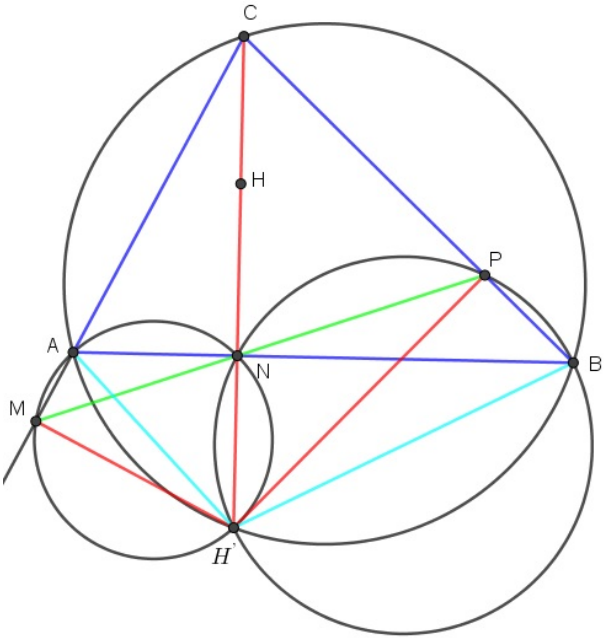
From the lemma it follows that the quadrilateral AHBCAH'BC is cyclic. From NAC=α\angle NAC = \alpha and ANC=90\angle ANC = 90^\circ it follows ACN=90α\angle ACN = 90^\circ - \alpha. From ANH=90\angle ANH' = 90^\circ it follows that AHAH' is a diameter of the circle around the quadrilateral AMHNAMH'N. Then AMH=ANH=90\angle AMH' = \angle ANH' = 90^\circ. From the last and from MCH=ACN=90α\angle MCH' = \angle ACN = 90^\circ - \alpha, it follows that ANCHMC\triangle ANC \sim \triangle H'MC. Then ANAC=HMHC\frac{AN}{AC} = \frac{H'M}{H'C}, i.e.
AN=HMACHC.() \overline{AN} = \frac{\overline{H'M} \cdot \overline{AC}}{\overline{H'C}}.\quad (*)
Similarly, we have that BNCHPC\triangle BNC \sim \triangle H'PC, i.e.
BNBC=HPHC, so  \frac{BN}{BC} = \frac{H'P}{H'C}, \text{ so }
BN=HPBCHC.() \overline{BN} = \frac{\overline{H'P} \cdot \overline{BC}}{\overline{H'C}}.\quad (**)

From () and (*) we have
Figure 3

ANBN=HMACHCHPBCHC=HMACHPBC.(2) \frac{\overline{AN}}{BN} = \frac{\frac{\overline{H' M} \cdot \overline{AC}}{\overline{H' C}}}{\frac{\overline{H' P} \cdot \overline{BC}}{\overline{H' C}}} = \frac{\overline{H' M} \cdot \overline{AC}}{\overline{H' P} \cdot \overline{BC}}.\qquad (2)
The quadrilateral AHBCAH'BC is cyclic, so
AHC=ABC=βandBHC=BAC=α. \angle AH'C = \angle ABC = \beta \quad \text{and} \quad \angle BH'C = \angle BAC = \alpha.
Then HBN=HBA=HCA=90α\angle H'BN = \angle H'BA = \angle H'CA = 90^\circ - \alpha. Hence
HBP=HBN+NBP=90α+β=90(αβ) i.e. PHB=αβ. \angle H'BP = \angle H'BN + \angle NBP = 90^\circ - \alpha + \beta = 90^\circ - (\alpha - \beta) \quad \text{ i.e. } \angle PH'B = \alpha - \beta.
From MHC=α\angle MH'C = \alpha it follows
MHA=MHNAHN=MHNAHC=αβ i.e. MAH=90(αβ). \angle MH'A = \angle MH'N - \angle AH'N = \angle MH'N - \angle AH'C = \alpha - \beta \quad \text{ i.e. } \angle MAH' = 90^\circ - (\alpha - \beta).
It follows HMAHPB\triangle H'MA \sim \triangle H'PB, i.e. HMMA=HPPB\frac{\overline{H' M}}{MA} = \frac{\overline{H' P}}{PB} or
PBMA=HPHM.(3) \frac{PB}{MA} = \frac{H'P}{H'M}.\qquad (3)

From (1), (2) and (3) and Menelaus' theorem for the points MM, NN and PP and ABC\triangle ABC we have
CMMAANNBBPPC=CMPCANNBBPMA=CBCAHMACHPBCHPHM=1, \frac{\overline{CM}}{MA} \cdot \frac{\overline{AN}}{NB} \cdot \frac{\overline{BP}}{PC} = \frac{\overline{CM}}{PC} \cdot \frac{\overline{AN}}{NB} \cdot \frac{\overline{BP}}{MA} = \frac{\overline{CB}}{CA} \cdot \frac{\overline{H' M} \cdot \overline{AC}}{\overline{H' P} \cdot \overline{BC}} \cdot \frac{\overline{H' P}}{H'M} = 1,
i.e. MM, NN and PP are colinear.

Want a route through all this instead of an archive? The track puts 2,000 problems in a working order, from AMC 10 level to the IMO shortlist.

Source: MathNet, licensed CC-BY-4.0. Statement and solution reproduced as published; topic and difficulty added by this site.