Exactly one integer stands in each cell of an table (). The number in any cell is equal to the arithmetic mean of the numbers in some two neighboring cells (i.e. in the cells having the common side with the given cell).
Find the greatest possible number of all distinct integers in this table.
Belorusija, 2012
Solution
**Answer: .**
Let be the maximal number in the table and be the minimal number. Consider any cell of the table where stands. Since is the arithmetic mean of the number in some two neighboring cells and . But all numbers in the table are no greater than , the numbers in and are equal to . Since and have the common sides with , they have no common side, so they are not neighbors. Since stands in , number must stand in two cells having the common sides with . One of them is cell and the other cell is different from ( and are not neighbors). It follows that stands in at least 4 different cells.
Similarly, stands in at least 4 different cells.
Thus, the maximal and minimal numbers stand in at least 8 different cells of the table. The number of all cells is , so at most different numbers can stand in the table. We construct the example for different numbers.
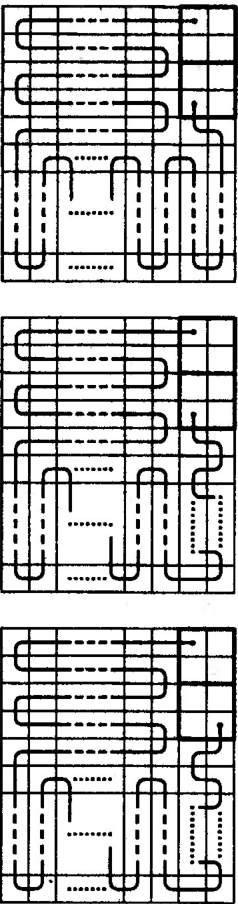
We mark two neighboring squares (see the fig.) and join these squares with the line passing through any cell of the table exactly one time as it is shown in the figures depending on the parity of and . We stand 1 in all cells of the first square and stand in all cells of the second square. We move along the line from the cell with 1 to the cell with . We put in each cell of the line the number which is 1 greater than the number in the previous cell. It is easy to see that the obtained table satisfies the condition and has exactly different numbers.
Want a route through all this instead of an archive? The track
puts 2,604 problems in a working order, from Junior Challenge level to the IMO shortlist.